


The Real Challenge of AI Agents Isn't Reasoning
 Onder Francisco Campos Garcia


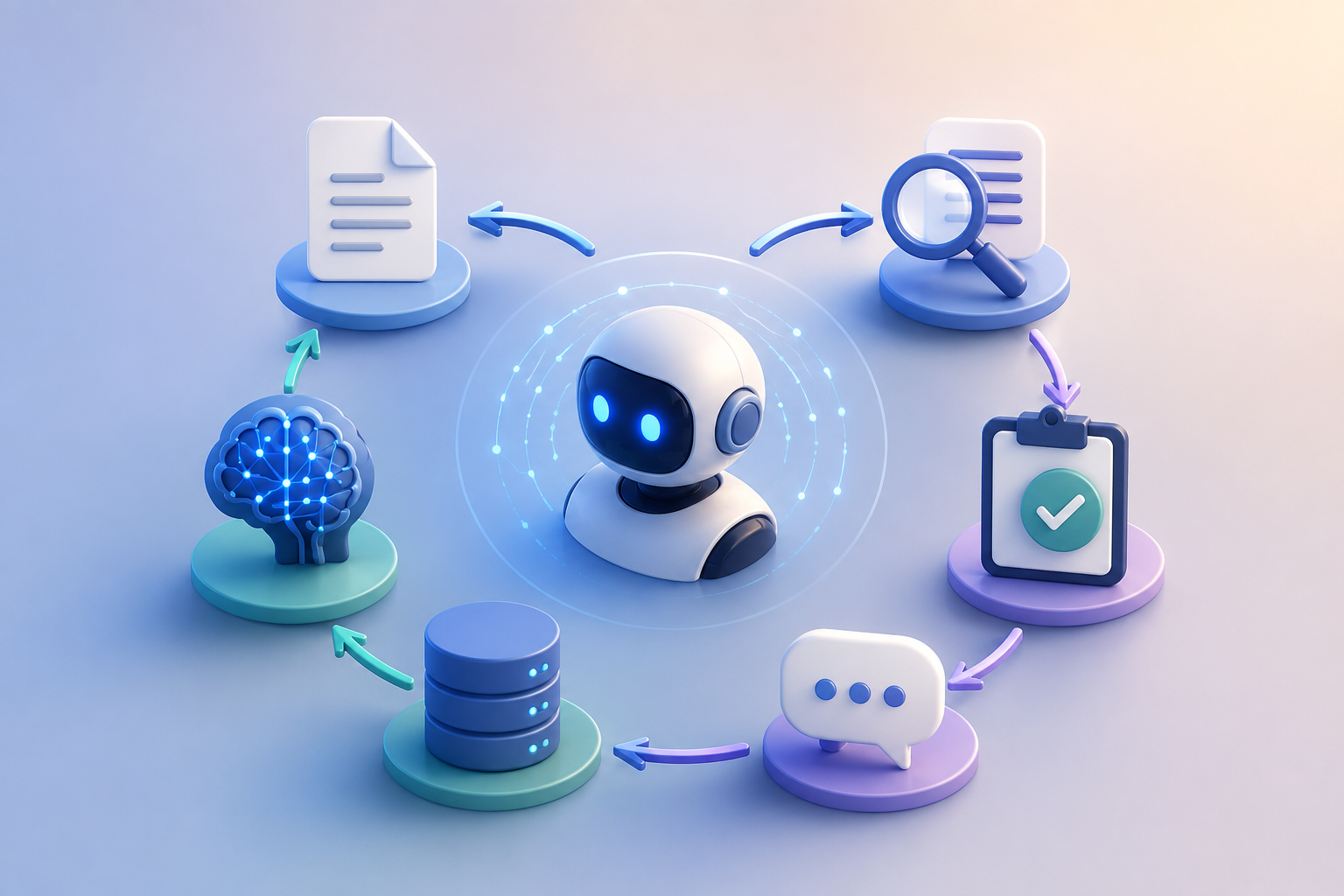
The emergence of AI agents has transformed the way we approach problems where traditional rules are no longer sufficient. Rather than anticipating and programming every possible scenario, organizations can now build agents capable of interpreting information, making decisions, and using tools to achieve a goal. However, a question is becoming increasingly important in enterprise AI projects: What happens after an agent completes a task? Does it truly learn from experience, or does it simply start over the next time it runs?
An agent may successfully complete hundreds of tasks and still begin almost from scratch when faced with each new case. To truly talk about learning, something more is required. The experience during execution must be transformed into reusable knowledge.
Large language models have significantly reduced the cost of building agents capable of reasoning and using tools. As a result, the primary challenge has shifted. It is no longer just about enabling an agent to complete a task correctly, but about enabling it to continuously improve after every execution. In other words, the challenge isn't building an agent—it's building one that evolves through experience.
Building a Knowledge Base
Our example system consists of two components. The first is an agent that generates documents using information provided through a form and existing content stored in a knowledge base. The second is the process responsible for building and maintaining that knowledge base. Although both components can benefit from continuous learning, this article focuses on the latter, leaving the former for a future discussion.
The knowledge base is built from thousands of contracts, manuals, policies, procedures, and other documents created over many years, each with different formats, structures, and levels of quality. In addition, the tools used to convert PDF or Word files into text may introduce errors, lose structural information, or incorrectly interpret tables and headings. Therefore, the objective is not simply to extract text, but to identify relevant information, eliminate redundancies, correct transformation errors, and build a structured and consistent representation of knowledge.
Perception and Memory
When an agent receives a document, the first thing it must do is understand what it is looking at.In a a continuously learning agent, this is called perception: the mechanism through which the agent gathers information from its environment and transforms it into observations it can reason about. In our case, this includes extracting content and identifying sections, headings, tables, and other structural elements.
The agent must also retrieve what it already knows. Memory is another key module and is typically divided into two types. Short-term memory maintains the context required to process the current document, while long-term memory stores strategies, patterns, and lessons learned from previous executions. By combining perception and memory, the agent can generate an initial structured version of the document.
However, at this point, the agent has only completed a task—it has not yet learned from it.
This distinction has important implications for organizations. If every new document requires the same level of human supervision, the benefits of automation eventually plateau. In contrast, a system capable of learning from experience can progressively reduce operational effort, improve result consistency, and adapt more quickly to new scenarios.
Correction as Feedback
Once the result has been generated, a domain expert compares it with the original document and makes the necessary corrections. The expert does not need to write rules, modify prompts, or train models; they simply continue performing a task that was already part of the workflow: validating the output.
The difference lies in what we do with those corrections. Every modification contains domain knowledge: what information should have been preserved, what could be removed, how a particular structure should be interpreted, or what the correct representation of specific content should be. In this way, correction stops being merely a human intervention and becomes feedback for the system.
From Experience to Learning
We can understand this cycle by borrowing several principles from Reinforcement Learning (RL). The agent observes a state (the document, its context, and the available knowledge) and follows a policy that guides its decisions and actions. In our case, this policy is not trained using traditional RL; instead, it is defined by the combination of the model, its instructions, available tools, memory, and previously learned lessons.
During execution, these decisions generate a trajectory: a sequence of observations, actions, and outcomes. Once execution is complete, the feedback provided by the expert makes it possible to evaluate that trajectory and transform it into an experience from which the system can learn.
This is the job of the learning meta-agent. Unlike the primary agent, its responsibility is not to process documents, but to analyze how they were processed. To do so, it reviews the trajectory alongside the final result and the feedback received, identifying what worked, what should be improved, and what knowledge can be reused in future situations.
Based on this analysis, the meta-agent generates lessons that may take the form of updates to the system prompt, new strategies, or additions to a dynamic knowledge repository. In subsequent executions, the agent uses this knowledge transparently, while the expert continues performing the same validation task. The expectation is that similar situations will require progressively fewer corrections over time.
However, learning does not mean automatically accepting every newly generated lesson. In enterprise systems, knowledge must also be governed. A strategy that improves one type of document may not be appropriate for another. For this reason, the system requires mechanisms that validate, evaluate, and, when necessary, discard knowledge that does not provide value.
Likewise, a newly generated lesson should not be considered valid simply because it exists. Its usefulness must be evaluated through subsequent executions and the system's performance metrics. If it contributes to better results, it can be retained or reinforced. If it adds no value, introduces new errors, or becomes obsolete, the meta-agent can modify or remove it.
In this way, the system does more than accumulate knowledge—it continuously evaluates and refines what it learns. We can think of this as a form of metacognitive learning, where the agent learns from experience while simultaneously assessing whether the lessons it derives genuinely improve its behavior.
Other Sources of Feedback
So far, we have used a domain expert as the primary source of feedback, but this is not the only option. In certain scenarios, part of the feedback—or even the reward signal—can be generated automatically through deterministic rules, quality metrics, specialized validators, reward models, or language models acting as judges.
In practice, multiple mechanisms can work together: automated validation for verifiable results, specialized models for more complex evaluations, and human experts for ambiguous, novel, or high-impact situations. This makes it possible to evolve gradually from a human-feedback approach to a hybrid model and, whenever feasible, to one that is largely automated.
Conclusion
Much of the effort involved in building applications powered by language models has focused on improving instructions: refining prompts, adding examples, providing more context, or defining additional rules. All of these remain important, but there is a limit to how much we can anticipate during the initial design phase. In real-world systems, new situations, documents, and exceptions will inevitably emerge that were never considered when the first prompt was written.
For this reason, the next step is not simply creating increasingly sophisticated instructions, but building systems capable of transforming their own experience into reusable knowledge. As the agent accumulates experience and performance metrics consistently demonstrate the required level of quality, human supervision can gradually decrease. Experts can shift from validating every result to focusing on exceptions, new scenarios, and periodic audits.
"AI agents deliver more than task automation; they improve with every decision they make.. We're no longer designing only how an agent should behave today. We're also designing how it should evaluate its own actions, learn from its outcomes, and perform even better tomorrow.
See how Softtek's FRIDA agents are built to learn from every execution, not just complete tasks.
.png?width=352&name=AI%20supply%20chain%20(1).png)