AI-Augmented Testing in Practice: Separating Hype from Enterprise-Ready Reality
 Hector Arturo Ramirez Flores


Artificial Intelligence has moved from experimentation to the enterprise agenda, and there is no turning back. Across industries—from financial services to healthcare and insurance—AI is no longer a side initiative but a strategic lever. As organizations bring AI into core systems, one question becomes critical: how does quality evolve to keep pace with intelligence?
The ambition vs. the operational reality
In software testing, expectations around AI are ambitious: autonomous testing, self-writing scripts, fully self-healing frameworks, and intelligent agents validating other agents. The vision is promising. The operational reality, however, presents a number of challenges.
Many AI initiatives struggle to scale due to gaps in governance, data readiness, and validation discipline as shown in research conducted by Gartner. The same principle applies to AI in testing. The issue is rarely a lack of tools. It is the absence of structured integration.
The key distinction is not whether AI is present in testing activities. It is how purposefully it is embedded.
Where AI is delivering real value today
Today, several AI-augmented capabilities are delivering real value.
Intelligent models can analyze requirements and historical defects to suggest comprehensive and meaningful test scenarios. Machine learning can prioritize regression suites based on risk, reducing unnecessary execution cycles. Self-healing automation reduces maintenance effort when application interfaces change. Synthetic test data generation expands coverage while keeping privacy and compliance controls in check.
These use cases are no longer experimental. Market projections reflect strong growth in AI-enabled testing solutions, driven by enterprise demand for faster delivery cycles and cost optimization. For example, Fortune Business Insights projects the AI-enabled testing market to grow from around 1.01B USD to 4.64B USD by 2034, with an estimated CAGR of 18.3%.
Yet adoption does not automatically translate into maturity, cost savings, or effort reduction. AI does not eliminate testing complexity—it redistributes it.
How quality engineering responsibilities are shifting
Instead of spending most effort on test script maintenance, teams must shift to managing model oversight, validating outputs, detecting variance, and enforcing governance controls. Quality Engineering becomes less about routine execution and more about strategic supervision.
When AI is integrated within a well-structured and controlled operating model, it enhances efficiency and insight. However, when deployed without discipline, it introduces uncertainty—or even chaos.
This is where expectations require calibration.
Why fully autonomous testing is still a frontier
To this day, fully autonomous, end-to-end testing ecosystems remain the final frontier in complex enterprise environments. Context-aware validation of complex business logic, adaptive interpretation of constantly changing requirements, and unsupervised agent-based verification still represent significant technical and governance challenges.
Autonomy without oversight can open the door to subtle failure modes that are harder to detect than traditional automation errors.
Generative systems can produce outputs that appear correct while mismatching with business intent. Reasonable yet inaccurate assertions, incomplete edge-case coverage, and silent shifts in model behavior are inherent risks of probabilistic technologies. Without structured review processes and observability mechanisms, speed can take over assurance .
Acknowledging these limitations does not reduce AI’s potential. It clarifies its role.
The path to enterprise-ready AI in testing
Leading organizations approach AI in testing progressively.
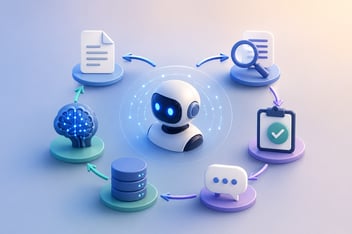
They begin by using AI to augment human capabilities, improving overall test coverage and accelerating well-scoped, repetitive tasks. They then integrate intelligent capabilities into automation frameworks to optimize execution and maintenance while freeing humans to explore testing scenarios and expand coverage.
As adoption grows, governance, monitoring, and compliance controls are formalized to support responsible scaling. This aligns with Gartner’s survey showing that long-term success with AI initiatives is strongly tied to operational maturity and governance practices.
This phased evolution transforms AI from experimentation into engineered capability.
The new role of the quality engineer
The broader implication is that AI does not replace Quality Engineering. It takes it to the next level.
Quality engineers shift their focus from maintaining scripts to analyzing risk patterns, validating intelligent outputs, and applying quality principles with greater impact. Their domain expertise becomes even more valuable as they evaluate AI-generated outputs against real business intent .
Quality becomes less reactive and more predictive. The central question moves from whether something failed to where systemic and operational risk is emerging.
In this transition is where meaningful competitive advantage exists.
AI as a multiplier for engineering discipline
AI in testing is not a shortcut to maturity. It is a multiplier for organizations that already treat quality as a strategic discipline.
When combined with governance, clear metrics, and expert oversight, AI can accelerate delivery while reinforcing reliability. When pursued as an autonomous replacement for engineering rigor, it can magnify complexity instead and bring undesired results.
The future of Quality Engineering in the AI era will not be defined by how quickly organizations automate. It will be defined by how intentionally they integrate intelligence with accountability, human judgment, and structured operating models.
AI does not remove responsibility from engineering teams. It raises the standard for it.
Explore Softtek's quality engineering services to learn how we combine automation, AI, leading frameworks, and top testing talent to accelerate delivery and maximize reliability.