The conversation with executives has changed. A year ago, the question was whether to invest in AI. Now it’s why the investment isn’t showing up anywhere meaningful. The tools are deployed. The pilots ran. The demos impressed. And yet most organizations are still running AI as an experiment rather than an engine.
That disconnect—between adoption and actual business impact—is the defining challenge of this moment.
Scaling AI beyond isolated use cases is genuinely hard. It requires rethinking how work gets done, not just which tools people use. And most organizations underestimate that until they’re already stuck.
Why AI adoption isn’t the same as AI impact
Two years ago, AI in the enterprise meant a chatbot or a recommendation engine tucked into a corner of the product. Today we’re talking about task-specific agents embedded in actual workflows—writing code, running test suites, triaging incidents, generating documentation. That’s a fundamentally different ask. It requires tighter iteration cycles, clearer governance, and teams that are genuinely close to the business context they’re working in.
The bottleneck I see most often isn’t the technology. It’s the distance between the people building the system and the people who understand the business it’s supposed to serve. That distance compounds over time. Decisions get batched. Feedback arrives late. AI models drift from the context they were built for.
What separates the organizations that scale AI from those that don’t
The organizations getting real results from GenAI aren’t doing something exotic. They’ve just made a few deliberate choices that most others haven’t:
-
Define the KPI before the model. Too many teams pick a model and then go looking for problems it can solve. Start with the business outcome—cycle time, defect rate, cost per transaction—and work backwards. AI is a multiplier. You still need to define what you’re multiplying.
-
Scale the work, not the team. The reflex when capacity is needed is to hire. But AI changes the math. A well-composed team with the right AI tooling can deliver what used to require a team twice its size. The organizations figuring this out aren’t growing headcount; they’re growing output.
-
Favor reusable IP over bespoke effort. Every time a team starts from scratch on something that’s been solved before, they’re spending time they don’t have. Proven accelerators, reusable components, documented patterns...these are what compress time-to-value from months to weeks.
-
Evolve the commercial model. Time-and-materials contracts made sense when effort was the unit of value. It’s not anymore. Start with AI-augmented T&M to establish baselines, then migrate toward output- or outcome-based models. Contracts that reward efficiency over activity create very different incentives—for both sides.
None of this is abstract. These are the patterns we see in the engagements that work.
What it looks like when the model actually works
At Softtek, the model we’ve built around this combines nearshore delivery with FRIDA (Framework for Intelligent Digital Automation)—our platform for applying AI across the full development lifecycle. Teams don’t start from scratch on problems that have already been solved; they apply proven components and adapt them. Governance gets built in from the first sprint, not retrofitted after something breaks.
In practice, that means testing cycles that used to take days running in hours. Feature delivery that doesn’t require adding people every time scope expands. Operations teams that can respond to incidents before they escalate. And as the model matures, it opens the door to something more fundamental: commercial agreements tied to outcomes rather than hours—which changes the incentive structure of the entire relationship.
What we keep seeing across the industry is a consistent split: companies with high AI adoption and uneven scaling. The tools aren’t the differentiator. Every company has access to the same models, the same platforms, the same APIs. What separates the ones generating real returns is how they’ve structured the work around those tools—the operating model, the delivery discipline, the feedback loops that keep AI aligned with what the business actually needs.
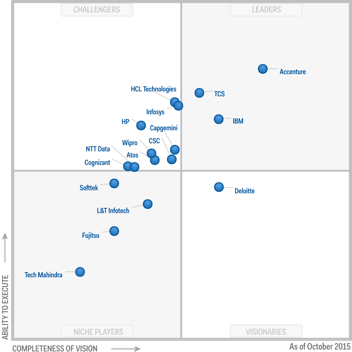
It’s a model that earned Softtek recognition as a Challenger in the 2025 Gartner® Magic Quadrant™ for Custom Software Development Services, Worldwide.
How to move from AI pilots to production at scale
I’m not sure when “we’re still in pilot mode” stopped being acceptable as an answer in a board conversation—but it has. The pressure is real, and the path forward isn’t more experimentation. It’s redesigning how work gets done so that outcomes become the default. That’s the conversation we're having now with every client who’s ready to move past the demo stage.
If you want to go deeper, we’ve put the full framework—including how to structure commercial agreements, governance from day one, and the path toward outcome-based models—into a white paper: Driving Results: How Proximity and GenAI Are Transforming Professional Services Outcomes.




 Alex Camino