What Gartner’s Recent Magic Quadrant Signals About the Future of Software Engineering
 Benjamin Burke


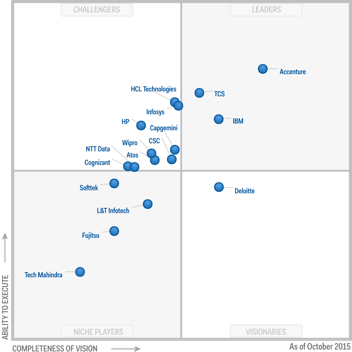
Softtek was recently recognized as a Challenger in Gartner’s Magic Quadrant for Custom Software Development Services, Worldwide (Dec 2025). We’re proud of that recognition—but the more important story lies in what the report signals about where enterprise software engineering is heading.
Across Gartner’s evaluation criteria and broader findings, a clear picture emerges: the next era of software engineering will be defined not by tools or point capabilities, but by how delivery systems operate end to end. Below are the most meaningful shifts buyers should pay attention to.
AI-native delivery is shifting from tools to operating models
For the past couple of years, most enterprise AI conversations in engineering have revolved around tools—especially code assistants. Gartner’s criteria suggest that phase is ending.
Yes, AI coding assistants will be mainstream: by 2028, Gartner projects 75% adoption among enterprise software engineers, with teams that apply AI throughout the SDLC achieving 25-30% productivity improvements.
But based on the report’s evaluation criteria, vendor positioning, and broader findings, a bigger shift also comes into view: the future of software engineering services is no longer about how smart your IDE is or what tools you’re adding.
Mature engineering providers are now orchestrating AI across capabilities such as:
- AI-assisted requirements decomposition
- Automated test generation and validation
- Security and architecture analysis
- Knowledge retrieval from codebases and documentation
- Release orchestration and operational insights
For buyers, this creates a simple litmus test:
- If a provider talks about AI mostly in terms of developer tools, that suggests they’re still experimenting. Gains will be local, not systemic.
- If they describe AI across the engineering system—governance, workflows, metrics, and delivery models—the conversation is more mature.
“Full-stack engineering” isn’t a differentiator anymore
Another quieter shift taking place is that capabilities that once differentiated engineering providers now barely register as differentiators at all.
Looking across the report’s evaluation criteria and how providers are positioned, modern enterprise engineering environments already assume things like:
- Cloud-native architecture
- DevOps and automation pipelines
- Built-in quality engineering and continuous testing
- Security integrated into delivery
- API-first and integration-friendly design
- Globally distributed delivery models
So, if a software engineering provider still positions DevSecOps, cloud-native delivery, or quality engineering as optional add-ons, that’s a red flag. Those elements should be embedded from the start and measured continuously.
For CIOs and CTOs evaluating partners, a useful question is:
“What capabilities do you consider baseline—and what do you consider differentiators?”
The answer tells you a lot about how mature their delivery model really is.
The real differentiation is moving “up the stack”
Across Leaders, Challengers, and many Niche Players, you see the same core ingredients:
- AI experimentation
- Cloud engineering
- DevOps pipelines
- Global delivery
That convergence signals that raw engineering competence is no longer enough to stand out.
Gartner’s evaluation emphasis points somewhere else: up the stack, into how engineering systems are designed and run.
Across the report, this shows up in how providers are evaluated and positioned—less on individual capabilities, and more on how they standardize, scale, and orchestrate delivery.
For example:
- Proprietary engineering platforms that standardize delivery
- Reusable accelerators and assets that drive repeatable outcomes across the SDLC
- Internal developer platforms that reduce cognitive load
- AI-orchestrated workflows that connect development, testing, and operations
- Governance models that scale quality and compliance
This shift reflects a deeper change in how enterprises build software. Organizations are focusing less on features and releases and more on building platforms, workflows, and capabilities that can be reused and scaled.
And once you make that shift, repeatability becomes the real competitive advantage.
The talent model is expanding, which means guardrails matter more
Gartner projects that by 2028, up to 40% of software team members could come from nontraditional technical backgrounds, enabled by GenAI and higher-level development tools. The report’s vendor positioning suggests this shift is already underway.
Hybrid and AI-assisted roles are already joining traditional developers.
Future engineering workforce may include more:
- Domain specialists
- Business technologists
- Citizen developers
- AI-assisted contributors
- Prompt engineers
That only works if the engineering environment provides strong guardrails. That means:
- Clear architectures
- Reusable components
- Quality automation
- Platform-level controls
- Well-designed developer experience
Without those systems in place, expanding who contributes to software development simply multiplies risk. Too many cooks in the kitchen.
The best engineering organizations—and their partners—are preparing for this shift now.
What this Magic Quadrant means for buyers
Seeing where vendors land is useful, but the deeper value comes from what the report signals about how a modern engineering partner is defined—and what that means for CIOs, CTOs, and engineering leaders.
A few practical implications:
- Treat AI as an operating model question. If your provider’s AI strategy is mostly about tools, you’re still in the pilot phase.
- Stop tolerating “bolt-on” quality and security. These capabilities should be embedded into the delivery system—not layered on after development.
- Ask how your partner industrializes delivery. Platforms, accelerators, and standardized workflows matter more than isolated engineering talent.
- Prepare for a broader definition of “engineer.” The organizations that succeed will combine human expertise with systems that scale safely.
And one final question that surfaces maturity quickly:
“What makes your engineering system repeatable—not just successful once?”
Because in the AI-native era, repeatability is where real advantage lives.
A challenger’s view of where the market is going
Where providers truly start to differentiate is in the identity they build around delivery—how work is structured, how engineering practices show up day to day, and how technology is used to create repeatable outcomes. In other words, how well everything works together as a system.
There’s no single “correct” delivery identity, so long as it’s grounded in the right things: real delivery systems (not just tools or credentials), the ability to meet clients where they are, and a model that evolves with the demands placed on it.
At Softtek, we make our software engineering services Simple, Smart, and Reliable. Let our team know what you’re working on, and we’ll show you what that looks like in practice.
%20(1).jpg?width=352&name=jason-edwards-BK--c7ZXtWE-unsplash%20(1)%20(1).jpg)