
 Softtek


Today’s businesses are drowning in data, as they are generating not only an increasing number of files, but the file sizes themselves are also growing rapidly. Managing this flood of data using traditional methods designed for local, non-collaborative environments has become a challenge for these companies.
Due to the limitations of traditional storage, organizations are moving to the cloud. For years there has been talk of the three basic types of cloud an enterprise can adopt, the public cloud, the private cloud and the hybrid cloud, the latter being the option most frequently chosen by enterprises. But what is particularly interesting is that companies moving to the cloud for file data storage are increasingly adopting a ‘multi-cloud’ approach when it comes to storing, managing, protecting and providing access to unstructured data.
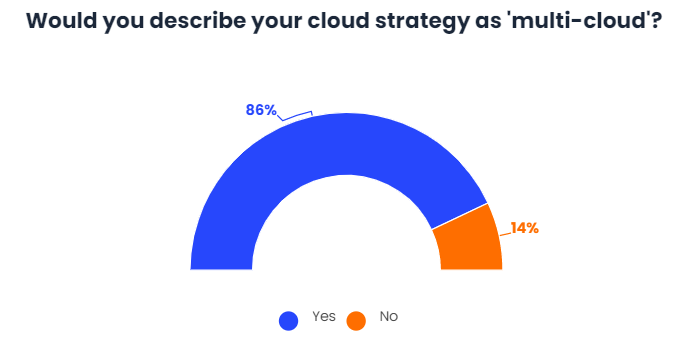
Even organizations that once only used the private cloud are including public cloud options in their strategy because they provide capabilities that are difficult to replicate in a private cloud. They have also found that the public cloud can be less expensive for some workloads. In fact, 86% of respondents (727 cloud strategy and application management decision makers in the US, EMEA and APAC) characterized their organizations’ cloud strategy as ‘multi-cloud’.
Businesses don’t just want to get files in the cloud, they want to share and access them across their enterprise, have their data fully protected and do it more cost-effectively, all of which requires a cloud with capabilities such as multi-site synchronization and global file locking.
The Multi-Cloud Model
In some cases, a single public cloud is not enough to meet an organisation’s computing needs. Instead, they turn to multiple clouds, which is an example of a more complex hybrid cloud that combines a private cloud with multiple public cloud services.
While a hybrid cloud always consists of a public and private cloud, a multi-cloud environment is slightly more varied on a case-by-case basis. In this case, an organisation’s IT infrastructure consists of multiple public clouds from multiple providers, although these clouds can be accessed via a single software-defined network.
In other words, a multi-cloud model combines cloud services from different providers, often to meet specific workload needs. These services may or may not be connected or organized between them. Therefore, under the concept of multicloud, it is managed as a single and complete architecture where resources and infrastructures of multiple types and providers are shared and connected.
At present, 81% of companies using cloud applications work with two or more providers. In addition, by 2021, 75% of medium and large organizations worldwide will have adopted a multi-cloud or hybrid strategy to manage their technology resources.
Benefits and drawbacks of multi-cloud environments
The main benefits of the multi-cloud model are:
- Economic efficiency. Decreases costs and increases long-term flexibility, mainly because organizations do not depend on a single cloud provider.
- When combined with private cloud assets, multiple cloud deployments allow organizations to achieve multiple objectives at once without having to radically expand or rethink their existing infrastructure.
- Resource availability is much more agile and natural.
- Risks are minimized and there is greater choice when adopting any type of service.
- Versatility and specialization. In enterprise-level organizations, for example, not all departments have the same needs in the cloud. Enterprises can choose from existing public cloud providers to ensure that each department has a solution tailored to its specific needs.
With regard to the disadvantages are the following:
- Poor planning can result in not getting “all the benefits” that this cloud model offers. This means that, when implementing solutions, you have to make sure they are designed for that type of model.
- Other aspects to bear in mind are security and the disaggregation of data, which is no longer concentrated.
- This is without forgetting the problem of vendor locking.
- When talking about multicloud, we must take into account what is needed and how the company will adapt to this new environment and whether this environment is reversible and interoperable.
Hybrid Cloud vs. Multicloud
The key differentiator to consider is that multi-cloud models involve the use of separate cloud environments to perform separate tasks. If an organization needs its IT infrastructure to be able to adapt to the conflicting demands of different departments, then a multi-cloud deployment is probably in order. For example, the sales team may need the CRM features offered by a specific cloud provider, while software developers may need different types of cloud computing environments that offer superior storage and processing capacity.
The difference with the Hybrid Cloud is subtle, but above all it brings to the table a number of important issues to consider:
- Multicloud requires much more detail in terms of security and management. The theoretical complexity of this Cloud model is much greater than in the case of the Hybrid cloud, and its distributed nature -in the sense that we may be dealing with different providers- requires it.
- Multicloud can generate adaptation difficulties, if we take into account the number of parts that move, manage and combine or communicate with each other.
- Multicloud can only add value to an organization if the right suppliers are chosen to meet the company’s requirements.
Of course, for many organizations, the choice between a hybrid cloud model and a multi-cloud model is a false dichotomy. There is no reason why a multi-cloud environment cannot incorporate the features of a hybrid cloud. While this is necessarily a more complex solution that requires careful implementation and security considerations, private cloud environments can be integrated into multiple public clouds to allow different users in an organization to access both the data and the cloud services they need to do their jobs more effectively.
Conclusions
In the future, it is becoming increasingly clear that multicloud is here to stay, but it is also evolving at a rapid pace. Without the right strategy, users could experience unnecessary complications, resource waste and inefficient use of cloud services. That’s why businesses have to think differently when it comes to this migration.
Still, at best, a sound multi-cloud strategy provides a way to store, secure, synchronize and collaborate on files globally, while meeting global data sovereignty requirements, controlling how to leverage analytics, avoid vendor lock-in and provide a business experience for all your global customers. With a multi-cloud approach, you can do all this without losing negotiating leverage or sacrificing flexibility.
Entities with 80-100 applications should consider such an architecture. This would also be the case for companies that want to combine the new software-as-a-service tools with more traditional ones that have been in use for decades and whose move to the virtual world requires special needs, such as adaptation to a private cloud or the deployment of a flexible VDC (virtual data centre) based environment.