
 Softtek


The 1990s saw the emergence of Web 1.0, representing the origin of the Internet. This was made up of static, read-only web pages created exclusively by a few developers. Initially, it was one of the greatest advances the world had ever seen, as anyone could access published content. However, users could only read and browse these web pages, but could not interact with them. In addition, there were no search engines available during interaction and browsing the internet was not a simple practice.
By the 2000s, Web 2.0 emerged. Its first iteration involved a single flow of information from the web publisher to the user, but its more advanced version allows significantly more interaction and participation. For example, users could generate their own accounts to have unique identities within the network. This aspect involved great benefits for businesses and for e-commerce, because they could cost-effectively market their products to a worldwide base of potential consumers online.
This made it easier for anyone to publish content on the internet, giving rise to the trend of blogs and user-published information sites such as Wikipedia. In addition, Web 2.0 developed and brought with it the rise of social networking sites such as Facebook, Twitter and YouTube. The development of web technologies such as JavaScript, HTML5 (HyperText Markup Language 5) and CSS3 (Cascading Style Sheets 3) during this time was fundamental in the construction of these interactive web platforms.
For some time now, there is a paradigm of developing the next level, Web 3.0. This would be a decentralised web that represents the latest generation of internet applications and services powered by distributed accounting technology, the most common being the Blockchain. In other words, a more open, intelligent and autonomous web.
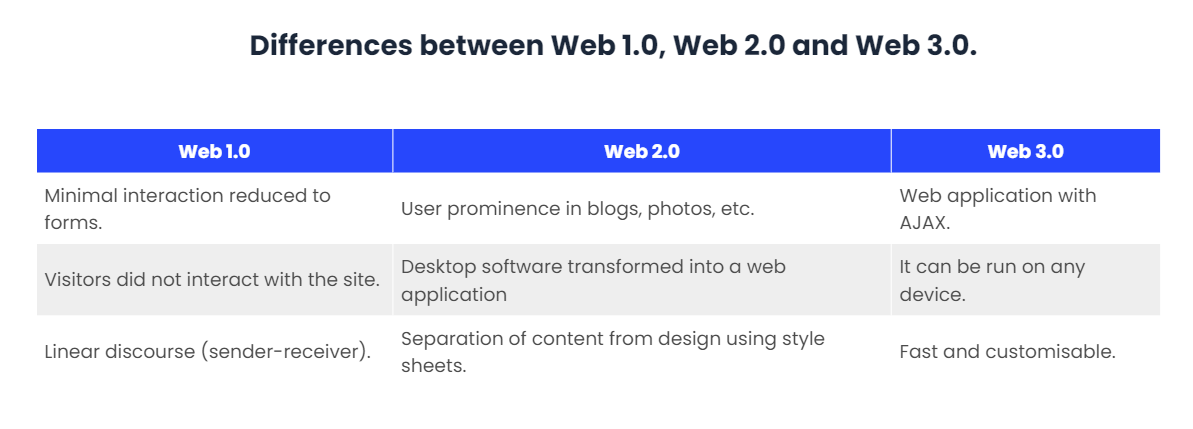
Thus, this new website focuses on connecting data in a decentralised way, rather than having it stored in centralised repositories, and working with computers capable of interpreting information in a similar way to humans. The result will be that machines and users will be able to connect more effectively with data, and so official will play a crucial role in making this web smarter and more capable of processing information. In other words, machines will be able to interpret in a granular way the meaning behind the data to generate smarter user experiences.
Web 3.0. does away with the shortcomings of centralisation that Web 2.0 and Web 1.0 had. Therefore, decentralised architecture seeks to address issues such as user trust, privacy and transparency, which by using Blockchain networks of decentralised nodes will be able to validate cryptographically secure transactions.
Decentralised protocols, the founding blocks of Blockchain and cryptocurrency technology will be interoperable, seamlessly integrated, automated through smart contracts and used to power everything from micro transactions, censorship-resistant P2P data file storage and sharing with applications such as Filecoin, to completely changing the way every company conducts and operates its business.
Benefits and features
The benefits that Web 3.0 will bring to the user are diverse, especially for areas such as social networking, through which they will have control over personal data, preventing it from being compromised repeatedly. The first decentralised social protocol for Web 3.0 powered by Blockchain is Follow and aims to give users full control over their own identities and social data.
Web 3.0 has been helped by the rise of NFTs, which are nothing more than digital collectibles and other online archives that can be bought and sold through cryptocurrencies. For example, a group of people banded together to try to buy a copy of the US Constitution through digital currencies, under the name ConstitutionDAO. DAO refers to a decentralised, autonomous, cryptocurrency-supporting organisation that brings together groups governed by blockchain and tokens, being the closest thing at present to the vision of web 3.0.
3D graphics will be fundamental as an attribute of Web 3.0 to give rise to a spatial network, with digital information existing in space. Virtual and augmented reality, 5G networks, IoT, AI and Blockchain will underpin this Internet by blurring the boundaries between the digital and the physical world. Some museum guides, architecture projects and computer games already show these early 3D designs. IoT devices will also be key to making Web 3.0 work through a host of new connected smart devices that will be used to access internet content at all times.
Obviously, this internet has been in development for a long time and has existing limitations especially in terms of data storage and data processing capacity, i.e. scalability remains a challenge in Web 3.0, as Blockchain technology continues to struggle with scalability issues, albeit decreasing.
Future outlook
Several companies are anticipating this transition from web 2.0 that generates services and access to their platforms in exchange for monetising and profiting from users’ personal data to decentralised applications that allow user participation without monetising data in web 3.0. data is shared with different applications and services that show different views for the same information and, in addition, users will regain ownership and control of their personal data.
These large centralised entities such as governments and multinational corporations must relinquish their control over profit-generating data, which means taking control away from them. Therefore, it is not expected that large corporations will want to participate in the adoption of this new Web 3.0.
However, with decentralisation becoming more important, it is an opportunity for individuals to take back control from the corporate giants that have dominated the internet. The aim is to achieve a fairer and more transparent internet in the near future.
Web 3.0 and cryptocurrencies
The blockchain aims to keep information organised in blocks through a reliable cryptographic hash to make them immutable and secure. When this web becomes a reality, the virtual world will see resources, applications and content that are accessible to everyone as long as the cryptographic keys are in place. There is a wealth of ways to make the virtual world more inclusive for every user.
The relationship with cryptocurrencies is that crypto players that offer the best technology to contribute to the ecosystem will receive the maximum attention. In relation to specific cryptocurrencies and investment prospects, it is presented as one of the most popular web 3.0 blockchain as it helps developments with decentralised applications. This puts it on the radar of long-term crypto investors. However, it is not the only one and there are quite a few chains that surpass others in terms of web 3.0 relevance such as The Graph, Filecoin, Livepeer, Helium and more.
Conclusions
In conclusion, the development of web 3.0 is important as some large companies have ended the internet, which means that individuals have lost control of their information and data. Organisations have required personal data to be provided in exchange for access to their platforms and services, which they have then monetised and used for profit.
Web 3.0 seeks that the user can regain ownership of their personal data, being the internet that provides the same benefits to all users, where 3D graphics, IoT devices, artificial intelligence, virtual and augmented reality, among other things are fundamental to create this new decentralised environment. Therefore, it is the decentralised architecture that defines the importance of web 3.0, emulating the original vision of the origin of the internet and Web1.0.