 Softtek


The Fourth Revolution has come as a solution to increasingly complex working environments. The introduction of cognitive and intelligent processes has opened up the possibility of a wide range of productivity improvements that are driving the digital transformation.
This in turn has posed its own challenges, as processes become increasingly digital and automated. Companies need to discover how to harness the potential of modern technological advances, such as the Internet of Things (IoT), cloud computing and machine learning to create operational and strategic value and gain an advantage over competitors. One method that will be invaluable in meeting these challenges, both now and in the future, is the Digital Twin concept.
The digital twin challenge?
Digital Twins are an almost real-time representation of the physical attributes of an organization, its products or its processes. By connecting objects that generate data in real time, a digital footprint of a product can be developed, from its design and development stages to the end of its production cycle.
The data can be processed and aggregated based on a number of criteria and presented in a variety of ways based on specific use cases. This will lead to the development of richer models and realistic measurements of the inherent unpredictability of a system.
In the past, it was not technically or economically feasible to handle the massive amounts of data required to generate highly realistic digital copies of an object. However, in recent years, computing, storage and bandwidth costs have fallen, allowing the rapid collection, aggregation and analysis of data, generated by intelligent, connected technologies.
Well-built Digital Twins can facilitate the simulation of possible scenarios and predict results, allowing new strategies to be tested without affecting production. This not only saves valuable time, but can also help identify potential failures with a forward-looking strategy before it is implemented in physical processes.
By analyzing the performance of the production chain and the quality of a product throughout its creation, processes can be optimized to make better products at lower costs. Near-real-time component tracking can alert relevant stakeholders to the eminence of breakdowns, allowing potential problems to be avoided before they actually happen through Predictive Maintenance. The Digital Twins can add more value by facilitating remote performance of support and other service tasks.
What do they bring to a company?
As explained above, the Digital Twins are not simply a digital model of the physical environment, they are a contextual model of an entire organization and its functioning. It is the data of its subsystems and the real-time interaction between its people, process and connected devices.
The Digital Twins solve the challenges of real-time data processing by bringing together data from IT and WO systems, IoT sensors and third party data into a contextual representation of your built environment. They allow you to analyze the complexity of your built environment, take immediate action to optimize conditions, and track and improve product health.
In addition, this technology makes it possible to improve the workspace, providing value in the different areas of a company and promoting a better working environment:
- They help to create dynamic spaces
Digital Twins can transform an obsolete workplace into a dynamic, modern and seamless one by gathering information and data from a variety of different sources and producing a contextual model, which can be used to optimize conditions and allow employees to interact with their spaces.
For example, if a group of employees needs to work collaboratively on a particular project, this technology can be used to match the group in a building space that offers the right characteristics.
- They provide information on the use of the building
How people interact with their office environment directly affects resource use and service needs such as cleaning and security. By having a better idea of how and when people use a space, you can find ways to increase or decrease resources or allow for more flexible use of space.
The Digital Twins discover these ideas by providing 360 panels, floor plans, analysis and other tools that offer real-time information on building use. They also help predict future states and optimize conditions, providing better results for everyone, including reduced costs for owners and a perfect experience for employees.
- They provide data for making business decisions.
With access to actionable data, the Digital Twins can help executives and workers make better decisions on a variety of issues and economic factors. For example, third-party service contracts can be better negotiated and deployed when data is reported by a Digital Twin.
Instead of using a static model to make decisions about services such as cleaning or maintenance, owners can employ a demand-based model that matches supply with changing needs. This makes it a smarter approach, resulting in better working conditions for employees and lower costs for employers.
- Improve employee experience
The Digital Twins gather data from connected devices and sensors to provide analysts with real-time information on changing building conditions. For example, using a mobile application, employees can change the environmental configuration of their workplace to create a more comfortable space. Digital Twins help determine the most efficient path to action requests and enable dynamic two-way communication between building staff and employees.
What role do digital twins play in industry 4.0?
Industry 4.0 represents the next step in the evolution of manufacturing companies. It has moved from purely physical systems, through augmentations with digital systems followed by interactions between physical and digital systems, to the current converging physical and digital systems represented by the Digital Twins, capable of accurately representing a physical system.
In this context, the Digital Twins can be used to evaluate production decisions prior to implementation and to visualize performance. Machines in a factory can also receive software and configuration updates wirelessly, eliminating the need for some levels of on-site support and allowing a centralized team to perform service tasks at multiple sites simultaneously, even in remote locations. By connecting different systems and processes, a product can be tracked and monitored throughout its production life cycle.
This opens the window for processing optimizations, higher quality products and reduced costs. With increasingly complex processes, the Digital Twins offer a unique opportunity to gain control of a complete system.
Digital Twins can have the greatest impact during the production and design phase. Their greatest advantages are through visualization, which improves human learning and decision making processes and helps discover areas that require attention; and collaboration, due to the fact that more stakeholders can gain an understanding of their machines and processes, no longer hindered by physical distance from the machines.
This technology is the present and the future, with its prevalence beyond the manufacturing world suggesting how common it is likely to become in all sectors. Already having a profound impact, Google Maps, for example, is a digital twin that a large percentage of the world’s population uses daily; mapping the real world into the virtual. Google’s use of Digital Twins is a good example, but it is not the only one:
- In early 2018, a European company made a Digital Twin in the city of Singapore, with the aim of studying in depth its operation.
- In China, at GALA’s Spring Festival, four human hosts joined their twins. These twins were created using a digital twin by ObEN.
In short, digital twins are here to stay and with countless opportunities for those who can take advantage of this exciting technology. In 2020, new advances will be made to accelerate simulations in Digital Twin environments using high performance computers. The success of this initiative will accelerate real-time programming and management of complex processes for the foreseeable future.
Conclusions
Digital twins are transforming business environments by creating perfect experiences for employees. With the deployment of Digital Twins on the rise, new use cases are being developed every day, and the technology is helping owners protect their assets in the future and attract in-demand employees by providing a superior experience.
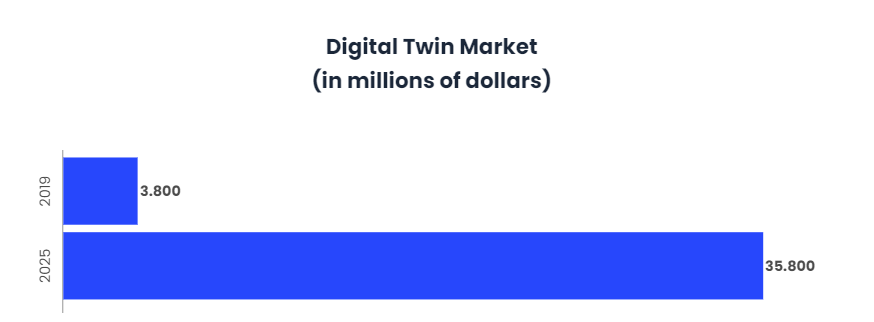
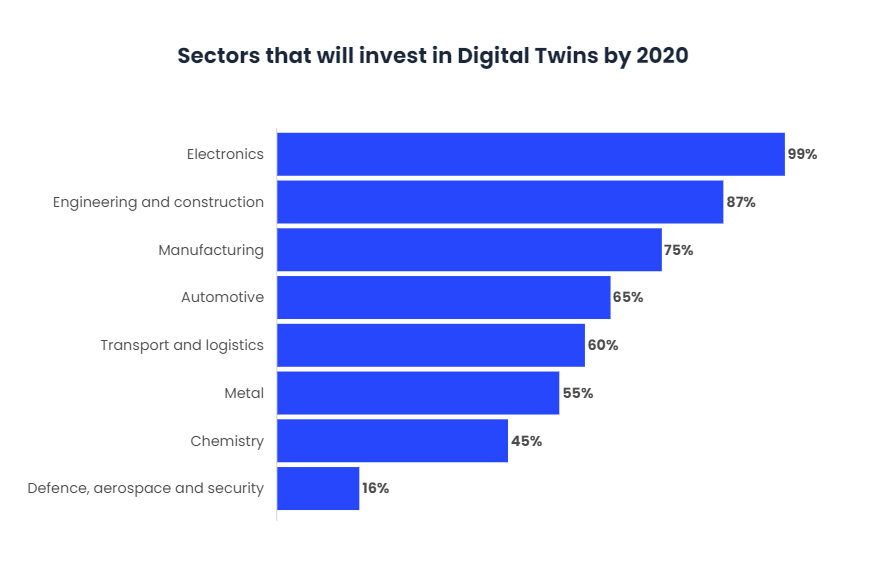
The benefits of the digital twin have played an important role in ensuring its adoption in various industries and predictions are that it will continue to have a higher adoption rate throughout 2020 than it did in 2019. Although Digital Twin solutions have become more interactive and intuitive, companies still require the assistance of experienced professionals to make the most of their environment, thus generating a new need for qualified personnel.