
 Softtek


The advance of digitalisation has come about thanks to the migration of many companies to the Cloud, where they seek to have immediate elasticity and adaptability to meet the needs of their business.
In addition, this migration involves simplifying and accelerating the processes of acquiring new technologies so that the development of the business does not become obsolete, being able to pay on the spot for the use of new technological tools available on the market.
However, the public cloud is well suited to a variety of use cases, but sometimes large enterprises cannot move data and the traditional core business and therefore need platforms that can deliver the benefits of the cloud to the traditional business.
However, companies have their private cloud, which is defined as a standardised platform that is certainly automated, but without the services that a public cloud provides such as unlimited scalability or a pay-as-you-go model.
Therefore, this is where the concept of hybrid cloud arises, as a combination of private cloud and public cloud resources. Although this concept has been around for at least a decade, in the last year, at least 87% of Spanish companies have adopted hybrid cloud architectures and 93% of these have a multi-cloud strategy.
A hybrid cloud is defined as a solution that combines a private cloud with one of the public cloud services, with unique software that enables communication between each distinct service. Adopting a hybrid cloud strategy creates greater flexibility for companies so that they can move workloads between cloud solutions according to their needs.
The services that a hybrid cloud can offer are diverse and powerful, giving companies greater control over their private data, allowing them to store sensitive information in a private cloud and simultaneously leverage the resources of a managed public cloud. Furthermore, a hybrid cloud relies on a single management plane, as opposed to a multi-cloud strategy where administrators must manage each cloud environment separately.
The giants Amazon and Google have created their own modern hybrid cloud services, AWS Outposts and Google Cloud Anthos, respectively. Both platforms provide enterprises with a range of options for those with large workloads distributed across public and on-premises environments.
Architecture
Adequate and uniform administration of the resources offered by the hybrid cloud is best managed individually in the cloud environments, as this avoids redundant processes and, at the same time, avoids security risks if the solution is not fully optimised for operation. By limiting the exposure of private data to the public cloud, many security risks are avoided.
Thus, hybrid cloud architecture includes a public platform in the guise of Infrastructure-as-a-Service (IaaS), a private cloud and access to a secure network. Many hybrid environments make use of local area networks (LANs) along with wide area networks (WANs).
For businesses to implement a proper and effective hybrid cloud strategy, public and private clouds must be compatible with each other in order to communicate, with an IaaS solution being adopted first and private cloud functionality being extended.
Generally, large service providers such as Amazon or Google have provided companies with a connection of their on-premises resources to a public cloud solution. However, it should be noted that APIs enhance native interoperability between services.
Hybrid architectures can implement a hypervisor layer to generate virtual machines that connect to the public cloud via another software layer that tools the cloud environments.
Also, it should be noted that not all businesses use the same level of computing power, and even an organisation may find that they are resource hungry only one time of the year. Therefore, the hybrid cloud allows a company to save costs by extending its private resources to a public cloud only when needed.
Finally, the hybrid model requires less on-premises space than a private cloud model, so a company can rely on an on-premises private network to handle its internal needs and automatically extend to a private cloud when compute resources exceed local availability.
Google Anthos
Google offers the management, deployment and monitoring of the different cloud platforms that a company has with Anthos in a single service. In addition, it is even capable of managing its own hardware infrastructure outside the cloud. The key, standout feature of Anthos is that it manages applications on AWS and Azure, ahead of its competitors.
Anthos provides a uniform platform for deploying any company’s legacy or cloud-native applications. It also builds containerised enterprise applications more efficiently in conjunction with Kubernetes, enabling an agile and scalable software delivery processing flow.
As mentioned above, Anthos allows users to run their applications on other major competitors’ platforms, taking advantage of the fact that the cost is for compute time used and storage. Google argues that this is the kind of tool that users are demanding for a hybrid architecture with different products that can communicate with each other or be managed together.
AWS Outposts
AWS Outposts acts as a hybrid cloud that allows users to host a public cloud-like environment on-premises, i.e. it is an on-premises IT-as-a-Service (ITaaS) platform from AWS.
This AWS platform coordinates everything in a single environment, making it easier to manage information. So with Outposts, it makes it easy for the user to use the same APIs and tools that are used in the cloud or on-premises. Likewise, the same is true for the hardware, with seats using configurable storage racks managed by AWS.
On the other hand, Outposts allows the user to monitor the status and performance of the system through a management console that has this hybrid cloud and has automatic updates to maintain the management software.
Finally, users can provision EC2 and EBS instances and volumes through Outposts. In addition, Amazon intends to add new services to support other AWS tools such as EKS, SageMaker, etc.
Conclusions
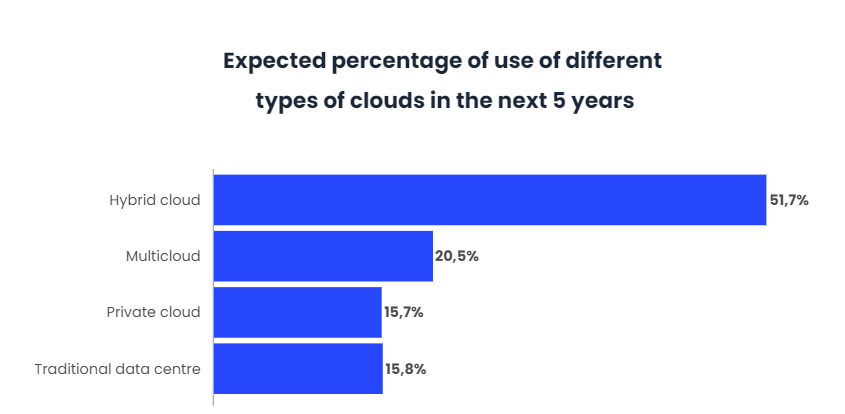
As mentioned, more and more companies are joining the hybrid cloud. Among the factors that are driving companies’ decisions to implement hybrid cloud is, firstly, security, as it is the cloud model considered the most secure, over private clouds and traditional data centres.
Secondly, the flexibility to choose an optimal structure for each dynamic business application required by the company makes IT teams select this type of Cloud, especially considering that the mobility of applications across clouds and cloud types is necessary.
In the last year 2020, it has been demonstrated that more and more companies are relying on the hybrid cloud, and the number of users is expected to continue to grow. This means that Google, Amazon and Azure are working under pressure to meet the needs of the new ways of working.
Spain has been one of the countries that has invested in this transformation, although its investment has been concentrated mainly in the private cloud, and it is expected to make a significant investment in the public cloud. In the coming years, companies will focus on migrating to multi-cloud and hybrid cloud environments, with hybrid cloud deployments reaching more than 50%.