
 Softtek


There is no doubt that 5G technology will be a before and after, a real revolution, in fields such as urbanism, IoT or Big Data. However, the adoption of the technology does not seem to be immediate, especially when it comes to implementation on smartphones.
The 5G promises more speed in data transmission, much faster than the 4G, technology widely used today. Thanks to this higher speed, consumers could access new services and experiences from their mobile terminal, but it seems that for this to be possible we will have to wait.
Adoption prospects from 2019 to 2023
According to recent data, it will not be until 2023 when mobiles equipped with 5G capacities exceed in market share those equipped with 4G. Moreover, the adoption of these devices will be uneven if we differentiate between regions, with consumers in Asia, especially Chinese citizens, pioneering the adoption of 5G mobiles.
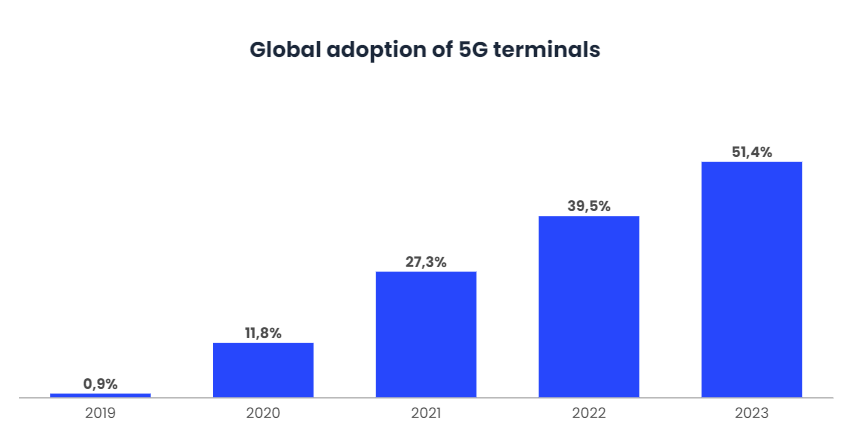
It seems that one of the reasons for the adoption of 5G mobiles are the government campaigns for the construction of the necessary infrastructure for the deployment of 5G. These policies are particularly noticeable in China and the United States.
In China, 5G licences started one year earlier than planned. By 2020, 17.5% of mobile phones sold in China will have 5G capabilities, a percentage that will rise substantially in the following years to 62.7% in 2023.
China’s rapid adoption is due not only to government support, but also to the increased presence in the country of manufacturers of key technology components. Chinese telephone operators will invest $5 billion this year to build, among other things, 70,000 to 90,000 5G service stations.
In terms of pure numbers, it is expected that by 2023 a total of 1.9 billion smartphones with 5G capabilities will have been sold. 13 million will be sold this year, 164 in 2020, 393 in 2021, 582 in 2022 and 774 in 2023 all of which means that the 5G mobile market will grow at an average annual rate of 179.9%.
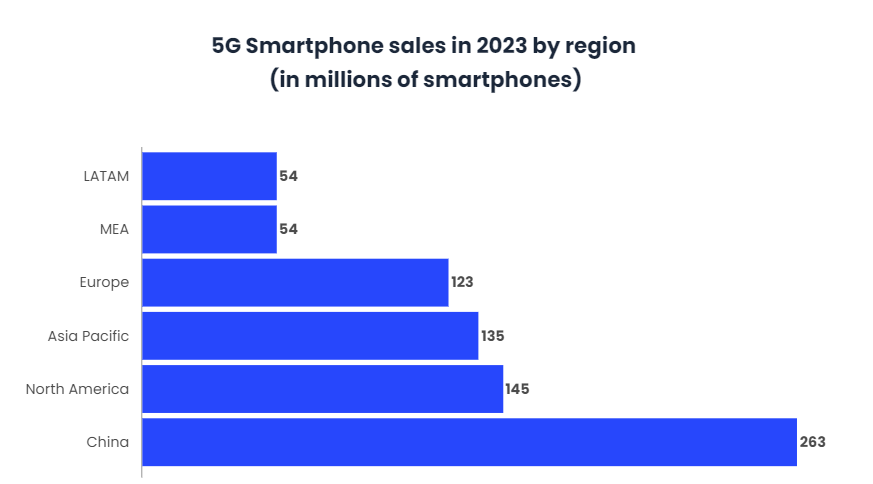
Other data of similar subject matter consider similar sales figures. In these it is expected that the adoption of 2020 or 2021 mobiles with 5G capabilities will no longer be a rarity but a reality. By 2023, 1.22 billion mobile phones of this type will have been sold, a figure that will rise to 1.793 billion in 2024, figures that are well below the 1900 million units forecast in the previous report. At that time the market share of 5G mobiles will be 63% in North America.
What both predictions do agree is that it will be in the Asia Pacific region (including China) that consumers will adopt the technology most quickly. However, it is estimated that the second largest market by 2024 will not be North America but Europe.
It is pointed out in these data that the definitive boost for the take-off of the technology will be the launch of mobile phones with these capabilities by major manufacturers such as Apple and Samsung. The US company is expected to announce an iPhone with 5G capabilities either in 2020 or 2021, while Samsung could do the same later this year.
The implementation of infrastructure will be necessary
The first mobiles with 5G capabilities launched in 2019 are not yet smartphones designed to connect to 5G networks only, but, given the absence of 5G communications infrastructures, these devices are 5G/4G hybrids.
In both the high or millimetre wave band (mmWave) and the coveted medium band spectrum, we will begin to see the initial wave of 5G-enabled smartphones in mid to late 2019, along with Wi-Fi portable or pocket 5G routers. Towards the end of 2019 and the first half of 2020, the second wave of 5G devices will include more 5G-enabled phones and laptops, as well as fixed wireless terminals (FWTs), which are critical to the deployment of a broader 5G infrastructure.
All this means that it is necessary to implement infrastructures that increase 5G coverage, an effort that is currently focused on the creation of 5G networks over existing LTE networks, which is costly.
It should be noted, however, that the purchase of a device with 5G capabilities does not mean that the user uses the technology. When it comes to contracting 5G mobile data plans, the outlook is bleak. Of the 8.8 billion subscriptions in 2024, only 1.9 billion will be 5G, or 20% of the market share.
The 5G is here
Although we have talked about the future so far, we must not forget the present, since the implementation of subscriptions that allow 5G capabilities is already a reality in several countries.
For example, it is estimated that there are already one million 5G subscribers in South Korea, Samsung’s home country, where 5G commercial networks were launched on April 3 of this year.
It seems that despite the initial difficulties in launching the technology, the installation of new stations as well as the promotion of the new Samsung Galaxy S10 5g and LG V50 ThinQ 5G has prompted consumers to adopt 5G.
It is expected that by the end of the year there will be 3 to 4 million 5G users in South Korea.
In the United States, the last company to launch a 5G network has been T-Mobile, which has deployed the network in 6 American cities. They point out that the main drawback for the adoption of 5G technology is the shortage of mobiles with 5G capabilities.
Another problem for T-Mobile is the low coverage of 5G networks. That is why the company has invested this year 842.5 million dollars in 24 and 28 GHz networks, capable of supporting an expansion of 5G coverage offered by the company.
In North America, in particular, the three major airlines that may soon be three have the task not only of building 5G infrastructure across the high and medium band spectrums, but also of transporting 5G-enabled devices to match.
In Spain, Vodafone began deploying its 5G network a year ago and a few weeks ago several Spanish cities had 5G coverage. The initial deployment has been carried out using the spectrum available in the 3.7 GHz band and will initially cover 50% of cities such as Madrid, Barcelona, Valencia, Seville, Malaga, Zaragoza, Bilbao, Vitoria, San Sebastián, A Coruña, Vigo, Gijón, Pamplona, Logroño and Santander.
Vodafone promises that thanks to 5G, customers who contract the services will be able to obtain speeds of up to 2 Gbps in download at low latency. In addition, Vodafone’s offering includes 5G roaming in Germany, Italy and the United Kingdom.
The UK was one of the last countries in which Vodafone deployed a 5G network in London, Bristol, Birmingham, Liverpool, Manchester and Cardiff. In this case, instead of being promoted as an improvement in the services offered to private customers, the company insists on the advantages that 5G could bring in fields such as remote health services or research thanks to the interconnection of the mobiles that make up the 5G network.
In Spain, several mobiles with 5G capabilities can already be acquired: the Xiaomi Mi MIX 3 5G, the Samsung Galaxy S10+ 5G, the LG V50 ThinQ and, the last to be launched, the Huawei Mate 20 X 5G.
It seems that Vodafone’s 5G network is not working optimally. It is difficult to find areas with coverage. The reason is that the network deployed is not 100% 5G because the towers and communication equipment used are the 5G NSA that have similar characteristics to those offered by the 4G at a frequency of 3.7GHz, frequency that is very limited to penetrate walls and buildings.
Even so, when the 5G can be connected, the download speeds are notably higher than in the 4G or 4G+.
Conclusions
The adoption of 5G will be slow but sure and by 2023 and 2024 we will be able to stop talking about 5G as a promise and see it as a reality. Although adoption in Europe will be slower than in Asia, the number of devices will not stop increasing until then.
On the other hand, a greater effort is still needed on the part of mobile manufacturers and telecommunications companies in the launch of mobiles with 5G capabilities and in the creation of the necessary infrastructures to support this type of networks respectively.
The first steps towards adoption are already being taken by companies such as T-Mobile or Vodafone, which already have 5G networks deployed and in operation, limited to large urban centers.