
 Softtek


The promise of digital transformation has led companies around the world to line up to digitize their business processes. This has not been done without proper assessment of results, as such transformation processes help companies create better value for the customer and, more importantly from a human resources point of view, develop more effective people management practices.
However, to learn more about how digital transformation is likely to benefit diversity and inclusion (D&I) initiatives, it may be important to look at how the digitization of business processes benefits from a diverse workforce and an inclusive work culture.
Although discussions and tribulations on the subject have been going on for decades, companies face a new work paradigm that promises to change much of how traditional workplaces have functioned in recent times.
Diversity has long been an important business consideration, often without a clear solution. The issue is to balance the workforce with the right talent and, at the same time, to provide a culture of equal hiring among the different categories of an active population, such as sex, age, race, religion, etc.
The response of the companies
The scope of digitization has been immense in recent years. While new companies such as Amazon, Airbnb and Uber have been able to completely revolutionize their respective industries and use a digitally-driven, fast-response, agile work culture, others have successfully adopted such techniques to reshape market shares and create better services.
For example, companies in the audiovisual entertainment sector have benefited greatly from successfully harnessing the power of digital technologies. However, it is not only the technological side of digital transformation that guarantees success. An even more critical aspect is the culture of the enterprise. A culture that, among other vital aspects, promotes diversity and inclusion.
Digital technologies are actively helping companies to reach their customers better and more effectively. To date, no conversation between business and customer has been as strong as in today’s era of digital connectivity.
As technologies actively shape customer preferences, companies must also respond by evolving their business practices. Technology can help predict such changes. And to leverage this knowledge, companies need a diverse workforce and a work culture that is inclusive enough to ensure that different voices find their way into the decision-making process.
That’s a necessary gear in a machine that drives innovation within them and allows them to take risks and reflect specific demographic preferences. Customers, with their needs, require companies to understand them better. To this end, software programs equipped with Artificial Intelligence and Data Analysis can help build solid predictive mechanisms, which, along with a diverse workforce can be the key differentiator of the brand.
Internships for the near future
From the youngest to the oldest companies, for many a supposed lack of ‘business case’ proves to be a major obstacle in the digital transformation and in particular in the adoption of a D&I strategy. However, there are many studies that defend this strategy as the key to success.
On the other hand, companies with women in management positions outperform those with no return on investment by 26%. This shows that a robust and effective D&I initiative helps companies make the necessary changes in their internal functioning and external performance.
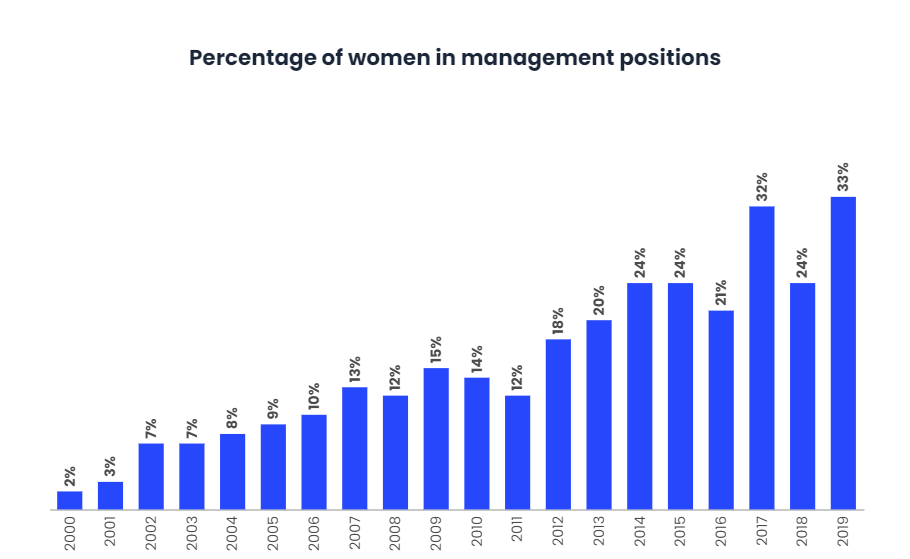
What is often missing to ensure that D&I initiatives are successful is the unique approach many organizations take to building a diverse workforce, forgetting new technologies when recruiting staff.
Some of the trends that are about to cause a stir in the near future are:
- Matching technologies:
New trends in matching technology go far beyond what job boards, Boolean search or keyword matching offer. Increasingly advanced algorithms and even Machine Learning technology provide faster and more efficient results.
New age-matching systems work 10 to 100 times faster and can generate results at scale. Because of this, even when the results produced by matching algorithms are simply equivalent to what a human recruiter could have generated, the time saved to get there is often enormous.
- Pragmatic advertising:
Instead of being a new form of advertising, programmatic advertising is instead a way of measuring the effectiveness of labor spending so that economic advertising resources can be directed to the most productive workplaces and platforms.
Programmatic advertising has already proven its effectiveness in several industries, making it easier for companies to see its effectiveness firsthand without investing heavily in implementation. In addition, they are easy-to-use tools that offer clear performance metrics and analysis so companies know if they are getting enough money for their advertising investment.
Simply having the data available is just one step to getting the most out of programmatic advertising. Today’s systems can behave dynamically according to configuration or rules set by individual companies. As a general rule, the amount a company saves through higher returns through the use of programmatic advertising should at least meet, if not exceed, the amount spent on the service.
- Social search:
Many companies say they have already adopted social search technology, but what they are actually doing is often a sort of “hunting” approach, taking advantage of networks of individuals to reach out and expose themselves. Social search technology does the same thing at scale, accessing all publicly available information about prospects and passive candidates from all social networks in order to find potential customers and get jobs in front of people who are qualified for them.
Social search technology works very much like any other job advertising approach, but instead of using a font like Monster or Careerbuilder, it takes advantage of social networks on all available networks. This makes it especially suitable for identifying passive candidates rather than just targeting active job seekers.
It is not intended to replace job boards and other tools, but rather to work integrally with them. To determine what percentage of total labour expenditure should be spent on social search compared to job boards and other tools, companies should carefully examine their recruitment needs and ensure that they have good analytics to measure which approaches work best for them.
- Recruitment Bots:
At this point, most companies have probably heard that recruitment robots are the wave of the future, but that statement is not so clear. Bots are already in the market, but the way they are best employed is still a work in progress.
While Bots may not yet be able to provide an enhanced candidate experience at every step of the process, they can certainly add value for some companies when implemented at the right points in the hiring process. The key is to determine exactly where those points are and position the Bots discreetly to perform specific tasks.
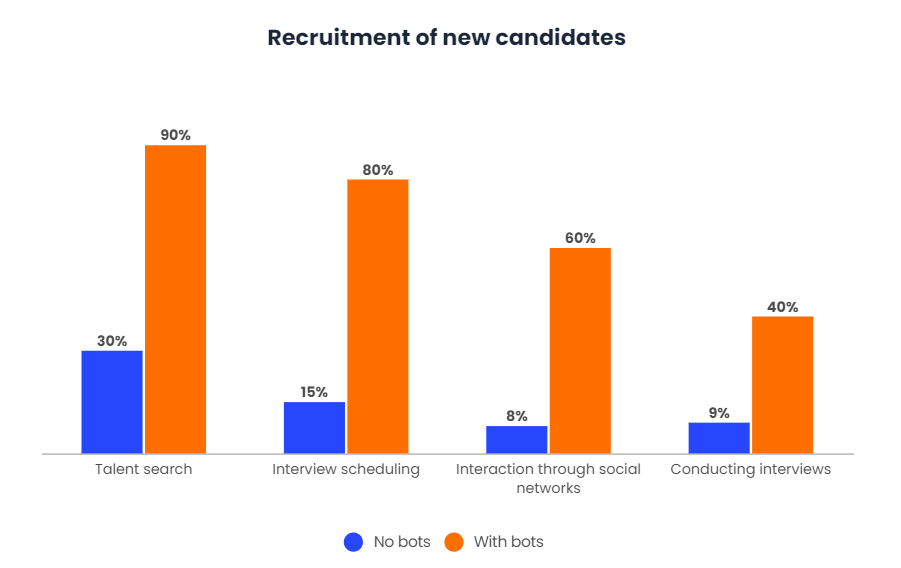
For many, it is not yet the right time to adopt Bots into existing workflows and recruitment processes. However, while Bots may not be an indispensable element, they will not disappear soon either, and now is definitely the right time for progressive companies to start paying more attention to recruitment Bots.
Bots can sometimes increase completion rates and collect more (and more focused) data when incorporated into the pre-application and implementation phases of the recruitment process. For other companies, Bots can replace a mundane, time-consuming activity such as scheduling interviews.
Conclusions
Experimentation with new technologies and trends can help keep companies abreast of developments that are rapidly becoming industry standards.
However, uninformed and reactive experimentation can cost companies a lot of time, energy and resources, often for very little profit. Companies must adopt new technologies when the cost of inaction is high and the risk of failure is low.
Most companies are already aware of this situation, so what they need is help recognising when the cost of ignoring a new technology is greater than the cost of adopting it.
Fortunately, keeping up with the latest trends does not always mean adopting a certain technology just for the good it can offer. Instead, companies need to be aware of what’s going on in the industry so that they know what’s available and when it’s the right time to start adopting new technology in their processes.