 Dan Berthiaume


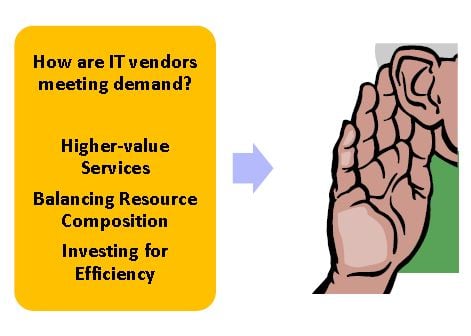
If the activities of 12 leading ITO vendors used as benchmarks by consulting/analyst firm Technology Business Research are any indication of the industry as a whole, then the global ITO 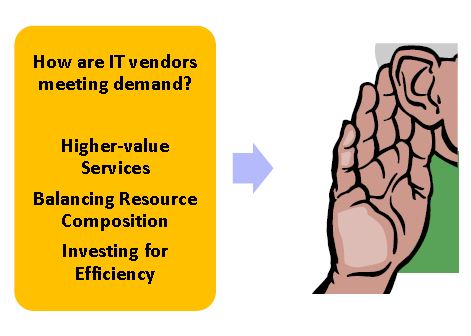 market is looking very healthy in 2012. According to a recent webinar hosted by TBR, “Following the Sun in 2012,” a benchmark group of 12 heavyweight ITO vendors including Accenture, Capgemini, and IBM are rapidly expanding headcount as they attempt to provide higher-value services, balance their resource composition, and invest for efficiency.
First, a brief look at headcount trends. As reported by TBR, the benchmark ITO vendors grew their headcount 12.2% year-over-year between Q4 2010 and Q4 2011. This overall growth figure encompasses a 16.3% increase in low-cost resources (including nearshore as well as other offshore resources), and a 5.8% increase in higher-cost onshore resources. ITO vendors are also increasing their staff levels to meet a growing global demand for cloud services.
Now to examine each of the three key market drivers in more detail. Benchmark vendors expanded consulting headcount and also increased the volume of more expensive onshore hires to support higher-value service offerings such as analytics/BI, cloud (as mentioned above), and mobility. Although in many cases adequately supporting the technical and operational complexities of these services requires more costly onshore hires, TBR data shows that higher-value offerings increased average revenue per employee for many benchmark vendors between 5 and 8.5% between 2010 and 2011. It is worth noting that three of the 12 benchmark vendors did see their average revenue per employee decline between 0.7 and 1.3% between 2010 and 2011.
Of course, despite the generally higher revenue per employee offered by higher value services, ITO vendors are still actively pursuing a staffing mix that includes plenty of lower-cost resources located in offshore regions. ITO vendors who achieve the proper resource balance can obtain the “best of both worlds,” with higher-cost onshore resources providing higher-value services and improving their ROI via increased average revenue per employee, and lower-cost offshore resources providing more basic services and offering some cost relief.
TBR data shows that the Asia-Pacific (APAC) region still dominates the low-cost ITO world, accounting for 53% of global low-cost headcount. The Americas (primarily nearshore) provide another 6.4% of global low-cost ITO headcount. However, low-cost ITO headcount grew 15.2% between Q4 2010 and Q4 2011, handily beating out APAC’s 11% growth rate in low-cost headcount during the same time period.
In terms of investing in efficiency, TBR data indicates more sophisticated ITO vendors are investing in automation and integrated industrialized delivery methods to improve efficiencies through standardization. In addition to making life easier on the client end, this improves profitability on the provider end, offering the elusive “win/win” result from the investment.
The nearshore ITO industry has many positives to take from this report. In addition to signs of healthy growth in nearshore headcount to provide more basic ITO services, ITO vendors’ focus on efficiency opens up opportunities for continued growth in nearshore headcount, including employees to support higher-value services. Education, IT infrastructure, political stability, and business climate are all improving dramatically in many nearshore ITO destinations, and factors like time zone, cultural similarities, English/Spanish proficiency, and ease of travel all greatly increase the potential for efficiency nearshore destinations offer.
The nearshore can help ITO vendors meet goals in all three key areas of services, resources and efficiency, and it is up to nearshore political, educational and business institutions to make sure ITO vendors are fully aware of this fact.