.jpg)


Quick Answer:
Retail facings are the number of product units displayed facing customers on a retail shelf. The right number of facings improves product visibility, strengthens brand recognition, and can increase sales by making products easier for shoppers to notice and purchase. Retailers determine the optimal number of facings based on factors such as product performance, available shelf space, store format, and merchandising strategy.
What Are Retail Facings?
Retail facings are a fundamental merchandising concept that influences how products are displayed and discovered in stores.
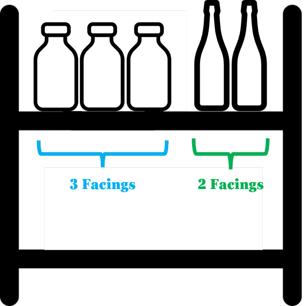
A facing refers to the space occupied by a single unit of a product displayed front-facing to the customer. It represents the basic presentation unit of a product on the shelf.
Facings, on the other hand, refer to the number of front-facing units or rows of the same product displayed side by side. Whether in grocery stores, convenience stores, pharmacies, or big-box retailers, facings help create organized, visually appealing shelves that improve product visibility and make shopping easier for customers.
The primary objective of retail facings is to maximize product visibility, improve accessibility, and ultimately increase sales.
What Determines the Number of Retail Facings?
The number of facings allocated to a product depends on several factors, including:
-
Retail establishment size: Larger stores may offer more facings for popular products, while smaller stores may have limited shelf space.
-
Commercial agreements: Deals between manufacturers and distributors can impact the amount of shelf space a product receives.
-
Product performance: High-performing products may be allocated more facings due to their sales value and units sold.
-
Product visibility: Products with more facings are more likely to be noticed by customers, increasing their chances of being purchased.
Visibility and Perception Thresholds
Visibility represents the minimum shelf space required for shoppers to notice a product during their shopping journey.
As Monzó and Clar explain in Marketing at the Point of Sale (2005), the visibility threshold is influenced by the average speed at which customers move through a store, directly affecting the time available to perceive products displayed on shelves.
Studies indicate that customers typically walk through retail environments at approximately one meter per second, while the human eye processes visual information in roughly one-third of a second. Based on these observations, the visibility threshold for a product is approximately 33.3 centimeters, meaning each product requires at least this amount of shelf space to be consistently noticed.
Store size also influences perception thresholds.
-
Small stores (under 100 m²): 20–25 cm visibility threshold
-
Medium to large supermarkets: 30–40 cm
-
Hypermarkets and department stores: 50–60 cm due to greater viewing distances and faster customer movement
How Retail Facings Impact Sales
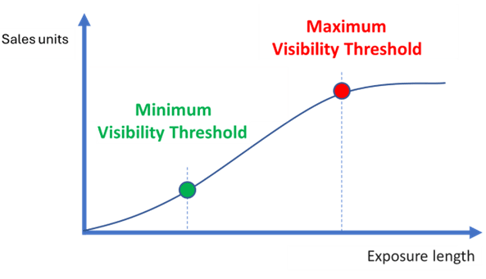 There is a well-established relationship between the number of retail facings and product sales. As the saying goes: "What isn't seen won't be bought." Research suggests that doubling the number of facings can increase sales by as much as 20%. However, this relationship is not unlimited. After reaching the visual saturation threshold—typically around 12 facings or approximately 90 cm—additional shelf space produces diminishing returns, with little additional impact on sales performance. This demonstrates why retailers should focus on optimizing, rather than simply maximizing, shelf space allocation
Maximizing shelf space
Because shelf space is limited, retailers must continuously balance product assortment, visibility, and profitability. An effective merchandising strategy considers both the number of products displayed and the number of facings allocated to each product to maximize shelf productivity and improve the customer shopping experience.
According to Yury Dario, a Category Manager Consultant with more than 10 years of experience leading merchandising and category management projects for manufacturers and distributors, optimizing retail facings requires balancing product visibility with business performance objectives. At Softtek, our retail experts help organizations leverage data, technology, and industry expertise to improve merchandising strategies and create better customer experiences.
Learn how our Retail Solutions help organizations modernize retail operations, improve merchandising performance, and deliver better customer experiences