


.webp)
 Benjamin Burke


With terms like nearshoring, reshoring, and even friendshoring, the outsourcing world has no shortage of shoring strategies. Some of these approaches have become essential to global business, with seemingly unlimited ways for companies to strategize how they handle global workflows. We “shore” wouldn’t want to cause any headaches, so here’s a quick breakdown of what each one means and why it matters.
Nearshoring
Definition: A strategy pioneered by Softtek in 1997, nearshoring refers to outsourcing services to nearby countries with similar time zones, cultures, and often languages. By keeping teams close, companies can enjoy smoother communication and faster response times without sacrificing the cost-effectiveness of outsourcing.
Why it matters: Nearshore is ideal for companies wanting high-quality, real-time collaboration with outsourced teams—without the cultural and time zone hurdles.
You might say nearshoring is “near” and dear to our hearts—after all, we invented it!
Offshoring
Definition: Offshoring involves outsourcing services to a distant country, often to tap into lower labor costs or specialized skill sets. This strategy allows companies to operate round-the-clock by taking advantage of different time zones, though it sometimes comes with communication and cultural challenges.
Why it matters: Offshoring is a cost-effective option for tasks that don’t require constant, real-time collaboration, making it ideal for 24/7 operations or specialized services.
Think of offshoring as outsourcing with a passport—long flights, but still worth the journey for the right project!
Onshoring
Definition: Onshoring refers to outsourcing work within a company’s own country. Instead of sending projects overseas, companies partner with local vendors or teams to keep operations closer to home. This option offers maximum alignment in culture, language, and often business practices.
Why it matters: Onshoring is ideal for organizations prioritizing proximity and cultural alignment over cost savings. It’s especially valuable for sensitive projects where close oversight or specific regulatory requirements are key.
Onshoring… because sometimes there’s no place like home (even in outsourcing).
Reshoring
Definition: Reshoring is the process of bringing previously outsourced work back to the company’s home country. This approach often happens after offshoring, when a business decides that closer control, better quality, or reduced logistical complexities are worth the move back.
Why it matters: Reshoring can help companies enhance control over production and streamline processes, especially when dealing with complex regulatory or quality requirements. It’s also popular in response to global disruptions that impact supply chains.
Think of it as welcoming your operations back from a study abroad—now they’ve got experience and they’re closer to home.
Friendshoring
Definition: Friendshoring, also known as ally-shoring, means outsourcing to countries that are geopolitical allies, often within the same trade bloc or military alliance. This strategy emphasizes working with partners who share political stability and mutual trust, reducing risks from geopolitical tensions.
Why it matters: Friendshoring helps companies build stable, resilient supply chains by sourcing from aligned nations, like those in the same trade or defense alliances. By choosing trusted allies, businesses can lower the risk of disruption due to international conflicts or sudden policy shifts.
Friendshoring is no different than a U.S. company nearshoring to Mexico, except there’s an extra layer of “let’s stick together just in case.”
Rightshoring
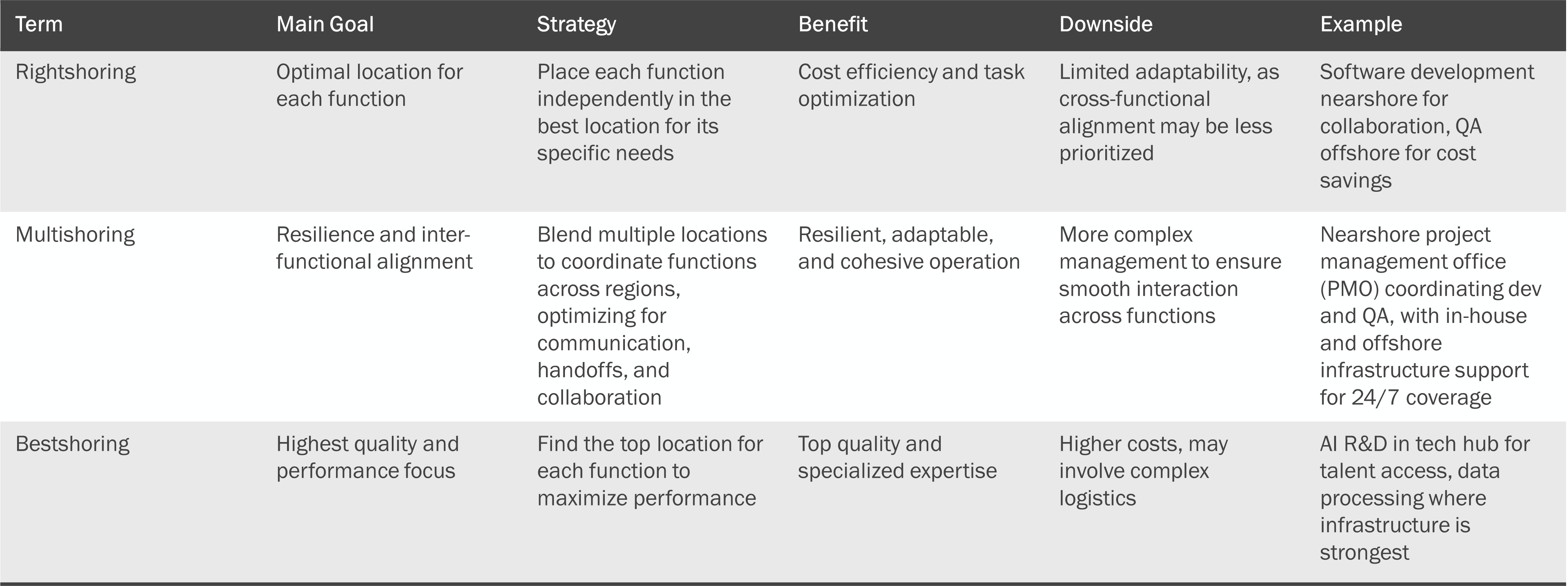
Definition: Rightshoring finds the most suitable location for each independent business or IT function based on specific needs like skill, cost, or efficiency. This creates standalone effectiveness for each task. For example, a company might choose a nearshore location for software development to ensure smoother collaboration within similar time zones, while its customer support operations could be handled offshore for round-the-clock service and cost savings. Each function is placed independently in the most “right” location.
Why it matters: By strategically placing each function in the most effective location, companies can achieve a balance of cost efficiency and task-specific optimization. However, by focusing on a single best-fit location per function, companies may sacrifice some adaptability, as less emphasis is placed on how each function interacts with others across regions.
An outsourcing buffet… Just cross your fingers that your vendor management department came with an appetite!
Multishoring
Definition: Multishoring is a coordinated strategy that involves distributing various business functions across multiple locations—onshore, nearshore, and offshore—to harness the strengths of each region simultaneously. Unlike rightshoring, which focuses solely on the optimal location for each task, multishoring considers how functions interact across regions to ensure the overall system is robust and responsive to changing needs. For instance, a company may consider the interdependence between project managers, developers, testers, and operations teams when selecting sourcing locations for a multi-year digital transformation initiative.
Why it matters: Multishoring provides companies with the flexibility to adjust resources dynamically across multiple regions, enabling more robust operations. By leveraging the strengths of various locations at once, businesses can mitigate risks, expand capabilities, and ensure seamless global coverage, adapting swiftly to changing demands or disruptions.
It’s like having a sommelier for your operations—you pick excellent sourcing locations and make sure each one pairs perfectly with the others. Full-bodied with notes of operational resilience!
Bestshoring
Definition: Bestshoring is all about finding the absolute best location to achieve the highest quality and efficiency for each task, regardless of location. A company following bestshoring may place its AI research team wherever the top talent and tech resources are, even if it’s not cost-effective.
Why it matters: Bestshoring enables companies to prioritize quality or innovation over proximity, making it ideal for tasks that demand top-notch expertise, like R&D or niche services.
It’s like that friend who built a lakefront mansion… on a mountain… with a grocery store just two minutes away. Only the best will do!
Summary comparison of rightshoring, multishoring, and bestshoring
Each of these sourcing strategies involves selecting optimal locations, but the intentions behind each differ. Let’s explore what sets them apart.
Conclusion
Each sourcing strategy offers a unique set of advantages—whether in cost, quality, speed, or global reach. However, focusing solely on the initial cost can obscure the broader, long-term value. We encourage companies to adopt a strategic mindset, viewing cost as one of many elements in their sourcing equation. With the right partner or a well-planned multishoring strategy, businesses can drive efficiencies year-over-year, accelerate time-to-market, and foster innovation, leading to significant ROI over time. By adjusting your cost calculations to consider these critical factors, you can make a choice that not only supports your bottom line but also fuels sustained growth and competitive advantage.
Want more insights like this? Check out our ultimate guide to nearshore outsourcing.
.webp?width=352&name=DALL%C2%B7E%202024-11-20%2009.15.05%20-%20A%20visually%20striking%20digital%20artwork%20of%20a%20metaphorical%20scale%20in%20balance.%20On%20one%20side%2c%20the%20scale%20holds%20abstract%20representations%20of%20hidden%20costs%20like%20a%20(1).webp)
.png?width=352&name=ChatGPT%20Image%20May%209%2c%202025%2c%2008_51_00%20AM%20(1).png)
.webp?width=352&name=DALL%C2%B7E%202025-03-13%2012.59.31%20-%20A%20breathtaking%20horizontal%20digital%20painting%20in%20a%20fine%20art%20paper%20cut%20collage%20style%2c%20symbolizing%20nearshore%20digital%20collaboration.%20The%20artwork%20features%20a%20%20(1).webp)