
 Softtek


The Business as a Service model has been expanding in the market in recent years. The benefits and advantages it offers in the context of digitalisation are clear, as it represents an evolved form of the outsourcing model that has traditionally existed in the business world. With the rise of large companies in the cloud sector (Google Cloud, Amazon Web Services and Microsoft Azure), terms such as Software as a Service (SaaS), Infrastructure as a Service (IaaS) and Platform as a Service (PaaS) began to resonate. However, market needs have paved the way for the development of a new model, Network as a Service (NaaS).
The term NaaS refers to a cloud service model through which companies or customers can obtain network services from providers, without having to incur the cost of maintaining their own infrastructure. In other words, it represents a comprehensive network infrastructure solution that is purchased on a subscription basis. This model helps companies to have state-of-the-art network technology at all times, eliminating the need for rapidly obsolescing equipment and the need to maintain and scale it.
To work, the NaaS model requires network virtualisation technologies such as Software-Defined Networking (SDN) and Network Functions Virtualisation (NFV). It also requires the integration of machine learning to carry out processes such as the automatic control and management of risks, threats and alerts in the network.
Undoubtedly, the current market situation with regard to digitisation undoubtedly calls for solutions that help to carry out the process effectively. Changes brought about by the healthcare crisis, technological advances, new ways of working and the impact of all this on the socio-economic environment have turned business flexibility from a competitive advantage into a necessity. The flexibility of today’s enterprises is directly proportional to the flexibility of their network infrastructure.
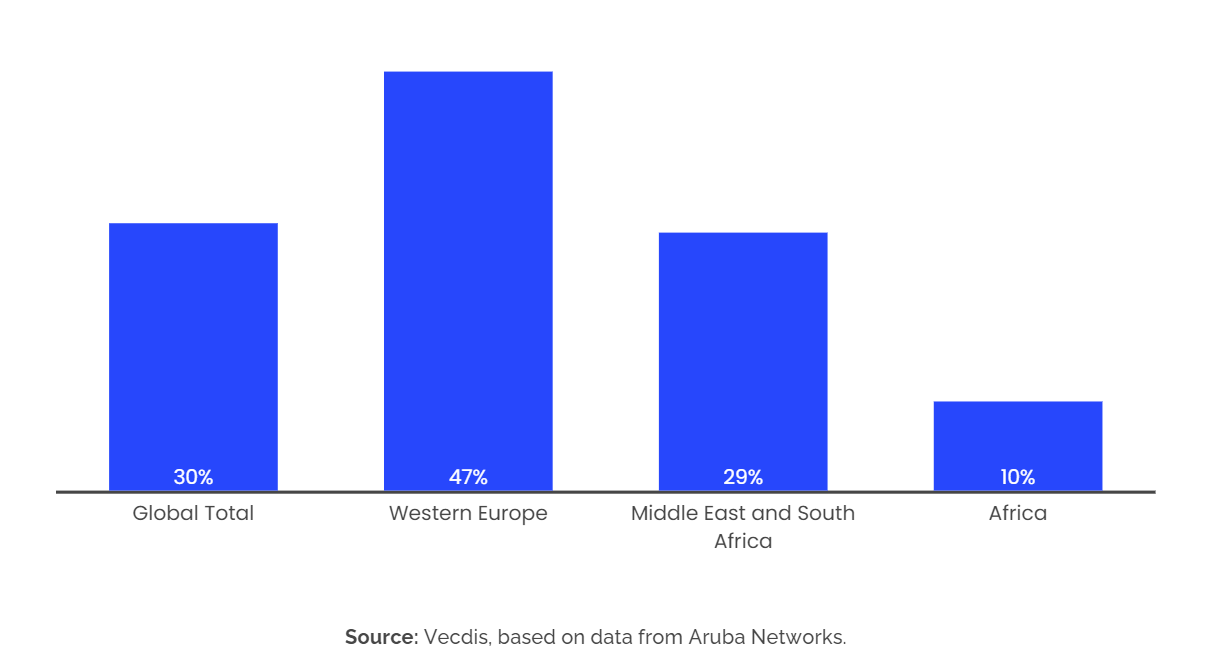
On a general level, NaaS is becoming more and more relevant within the business strategy. According to a study published by Aruba Networks in January 2022, 30% of companies globally are evidencing the implementation of the NaaS model as a recurring topic of discussion. This figure rises to 47% in Western Europe, indicating that almost one in two companies are considering the model as part of their business strategy.
Consideration of NaaS as a recurrent topic of discussion in business strategy by geographic region
Advantages of the NaaS model
NaaS allows a company, regardless of where its employees are located, to connect to its cloud servers directly through a digital network offered by a provider, so IT departments do not have to cover the demand for network services.
The main benefits of implementing NaaS within the enterprise technology ecosystem include:
- Payment for the network capacity consumed.
- Scalability, as more capacity can be easily acquired if needed.
- State-of-the-art network availability.
- Easier deployment of complementary applications.
- Reduced network complexity.
- Increased flexibility and customisation, as companies can configure the service on demand.
- Reduced management costs.
- No maintenance required, as the service provider manages updates.
- Increased security levels due to the existence of a single network provider.
Challenges of the NaaS model
On the other hand, the main challenges facing NaaS include issues such as:
- Time and complexity. Migration is often a complex and time-consuming process that requires the investment of time to address the company’s security infrastructure.
- Compatibility. Legacy systems can sometimes be incompatible with the NaaS offered by the provider.
- Legacy data centres. When data centres are still on local servers and not in a cloud environment, migration becomes even more difficult.
- Vendor lock-in. Moving services to a cloud environment risks developing a high degree of vendor lock-in.
- Dependence on WAN connectivity. A failure or interruption in the WAN connection has a negative impact on the company’s network operations.
- Uncertain pricing. As an emerging technology, there is still a lack of clarity regarding the prices that may be involved in its implementation within a company.
Future projection
Although the NaaS market is still in its incubation phase, its future prospects are promising. With the advance of cloud computing and pay-per-use, NaaS is expected to become increasingly consolidated within companies. In fact, Markets and Markets forecasts that this market will grow at a CAGR of 29.4% between 2021 and 2026, from $10.4 billion in 2021 to $37.5 billion in 2026 [5]. According to Antonio Navarro, sales director of D-Link Iberia, the proposition is very appealing to customers. It is expected to have a broad impact in a number of areas, with mobility, multi-device networking, security integration and resource expansion being the main beneficiaries.
Also, enterprises typically have a high degree of control over security in their network, relying solely on them. However, by relying on a vendor’s network, there is a risk of losing access to information that may be important to the security and operations team. In this vein, hybrid NaaS and Security as a Service models are expected to emerge in the future. However, being able to have complete confidence in a provider on security issues will be difficult, especially for companies that have to comply with stringent regulatory requirements.
Emerging companies in the area of NaaS solutions
Many companies are investing in developing advanced NaaS solutions tailored to specific market needs, including the following:
Aryaka (United States). The company offers a managed network and security service based on SD-WAN and SASE architecture that is easy to use and does not require a complex training process. The SD-WAN as a Service offering gives customers the ability to use the network through a cloud system. Key differentiators of its service include the integration of multi-cloud connectivity to boost application performance and the offering of a variety of cloud edge services. Their system includes predictive analytics and machine learning as tools for performance monitoring. They also have Network Security as a Service (NSaas) and Remote Virtual Private Network as a Service (VPNaaS) solutions.
Perimeter 81 (Israel). Its NaaS service incorporates network management and security on resources stored in cloud architecture compatible with Google Cloud, Microsoft Azure, AWS and Salesforce. It includes tools for authentication, DNS filtering, breach prevention and Wi-Fi network security. Its differentiators include issues such as encrypting information as it flows through the network and promoting zero-trust policies.
Cloudfare (United States). Its Cloudfare Magic WAN service replaces legacy WAN architectures, providing global connectivity across its network, cloud security and performance monitoring through user interfaces. It enables secure connection to the network from any source (data centres, offices, electronic devices and cloud properties). Among its key differentiators are elements such as connection to any type of hardware, availability in more than 200 locations worldwide and the availability of benefits due to partnerships with vendors such as VMware, Aruba, Digital Realty and CoreSite.
Conclusions
In conclusion, it can be said that developments in technologies offered as services have been evolving significantly in recent years. One of the new trends that is currently becoming evident is the Network as a Service (NaaS) model, as it represents a way to enhance flexibility in companies and solve the problems that currently exist to achieve digitalisation within business processes.
This technology offers important benefits and advantages such as scalability, reduced management and maintenance costs, availability of state-of-the-art networks and payment adapted to the required capacity. However, there are also certain disadvantages to be considered, the main one being that the NaaS model is still very new, so the true market potential is unknown.
However, what is clear is that more and more companies are interested in adopting NaaS, so considerable market growth is expected in the future, with new and improved technology solutions being developed thanks to capital investment by companies that want to be part of and grow in this sector.