
 Softtek


The growth in technology in recent years has highlighted the need for memories that meet the requirements of today’s computing. Some of the models currently being used for this are Static Random-Access Memory (SRAM), Dynamic Random-Access Memory (DRAM), Electrically Erasable Programmable Read-Only Memory (EEPROM) and flash memory.
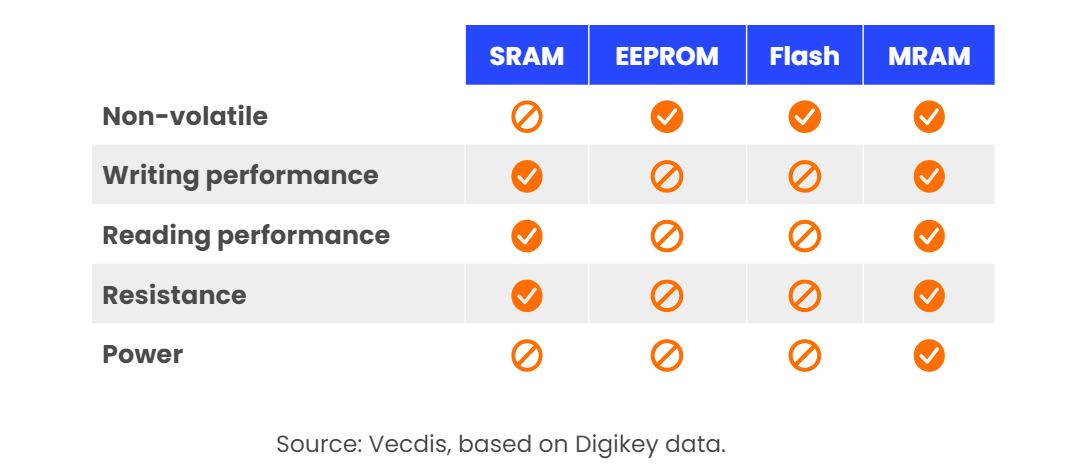
However, each of these technologies has barriers in different areas, so they are not up to state-of-the-art computing. This is where Magnetoresistive Random-Access Memory (MRAM) comes in, an innovative solution with low latency, low power, timeless endurance, zero volatility and scalability.
Comparison between different types of memory
The revolutionary thing about MRAM memory lies in the way it stores data. It leaves behind the idea of using current charges or electrical flows to implement magnetic storage elements. They consist of a pair of ferromagnetic disks spaced by an insulating layer. The data is interpreted as one of the discs is placed on a magnet in a fixed position, while the second disc moves to match the magnetic field of the first disc, changing from positive to negative. Interpretation is possible because the logic of binary numbers is followed.
This means that data is no longer only stored on memory chips, but can also be processed on them via memory networks. In this way, different processors are no longer necessary to carry out this procedure. With this model, large amounts of data stored in the memory network can be processed without having to be moved. This is why MRAM memory could be used for a wide range of applications, from system computing to storage.
The production of DRAMs is not the most complicated phase, in fact, they have been in production for two years now. Its technical difficulty lies in its implementation and operation, as today’s standard computing architecture is based on current-sum. The low resistance that characterises MRAM memory means that power consumption cannot be reduced when used in standard computing devices.
MRAM is still considered an emerging technology and it will take time to identify its true potential and impact on the market. At the moment it is already seen to be useful in areas that need to address memory technology issues by increasing durability and performance, including aerospace, automotive, defence, robotics, healthcare, IoT, edge computing, energy management and automation, artificial intelligence and machine learning.
Overall, there is a lot of interest in the implementation of MRAM, with startups and companies already producing it, while others are committed to research and investment for more and better advances.
Samsung is ahead of the rest of the tech world
On 13 January 2022, Samsung Electronics issued a press release announcing the demonstration of the first global MRAM memory-based computing. The company has been researching and successfully fusing MRAM memory with semiconductor devices for advanced artificial intelligence chips. To address the problem of low resistance, Samsung opted to replace the traditional current sum computing architecture with a resistance sum architecture, solving the problem of low resistance in MRAM memory.
According to data provided by the Korean multinational’s research team, the memory was successfully tested by evaluating its performance in artificial intelligence computing, achieving 98 per cent accuracy in classifying manually typed digits and 93 per cent accuracy in detecting faces in different scenes.
The Samsung research group also hinted at the possibility of implementing MRAM memory for offloading biological neural networks, so its use could be even more far-reaching than initially assumed in the area of in-memory computing. What is already clear is that this breakthrough represents a milestone in the development of low-power artificial intelligence chips.
Startups with projection in the development of MRAM solutions
Several global start-ups are offering solutions in the development of MRAM memory or architecture for its implementation, some of the most prominent being the following:
Numem. The US startup developed low-power MRAM memory solutions. Its NuRAM & SmartMem Smart Compute Memory IP Cores solution provides 20 times less leakage current than standard SRAM memory, while occupying 2-3 times less space. In addition, its memory ensures an additional level of on-chip security. Due to its high radiation resistance, the technology solution is located inside the NASA DNN Radiation Hardened DNN coprocessor chip.
LoMaRe. The UK-based start-up developed a new patented solution called PiezoMagnetic RAM (PMRAM). The technology is a versatile two-terminal platform that enables up to 25,000 times lower power consumption per bit compared to traditional memory and supports operation at temperatures of more than 125 degrees Celsius. Its first product, still under development, will be a low-capacity, two-dimensional PMRAM memory, built to replace flash and SRAM in the automotive, IoT and computing industries. It is expected that in the future it could also be used as memory for computers and mobile devices.
Blueshift. This British startup is also making developments in the MRAM memory sector. The company is researching new memory modules to reduce the performance gap between CPUs and RAM. The proposed solution in this case focuses on architecture, so that regardless of the type of memory used, it provides considerably higher speeds than conventional systems. Its technology is capable of accelerating MRAM and other memory data cells.
Conclusions
In conclusion, MRAM memory represents a significant advance in the development of data storage technology for computer systems as it offers solutions to the problems that conventional memory has. It has higher read and write performance, higher endurance, lower power consumption and zero volatility.
The problem with MRAM is not in its production, as it is a milestone that was reached several years ago. However, its problem lies in its implementation, as the characteristics of today’s computing devices make it impossible for the memory to have low power consumption.
Samsung Electronics managed to solve this problem a few days ago, announcing the development of a new architectural solution that replaces current-sum systems with resistor-sum systems, making the most of MRAM memory in the area of advanced artificial intelligence devices.
Several start-ups are also working on developing MRAMs or architectural solutions for their effective application, including Numem, LoMaRe and Blueshift.