
 Softtek


In the last two years, large companies have been expanding their AI and machine learning efforts to implement different AI-based production models. These organisations are increasingly betting on Machine Learning models, but currently, only half of these are implemented.
It is estimated that the total annual value generated in investments to implement AI is between 9 and 15 billion dollars. However, much of this potential value is lost if analytical models are not brought into production. Several companies have identified the shortcomings of the implementation process, and ModelOps has emerged as a solution to the challenges of implementing AI in production models.
ModelOps allows AI models to be introduced into production, and for development teams to easily incorporate these models into the software applications of each AI-driven tool. These tools are intended to automate a continuous monitoring of the process and address the changes needed to optimise and improve performance, so as to detect if the production model is becoming obsolete and, consequently, carry out an update of the model.
What is ModelOps?
ModelOps is a holistic approach to creating analytics models that can be rapidly introduced into any company’s production. A major focus of ModelOps is to automate the implementation, monitoring and continuous improvement of data analytics models running within the enterprise. This technology is a variation of DevOps.
ModelOps focuses on application analysis, while DevOps focuses on application development. Thus, the model in question, which reflects DevOps practices to ensure compliance, security and IT manageability, is crucial for predictive analytics to improve process performance.
The ModelOps concept defines the people, processes and technology to help organisations get the most value from analytics, taking into account all new production models.
As models degrade, an update is needed, trying to adjust and implement new performance parameters, these include:
- Set and track model accuracy targets through development, validation and implementation.
- Identify business metrics affected by the model in operation.
- Track metrics such as data size and update frequency, locations, categories and types. These metrics can help determine whether model performance problems are the result of changes to the data and their origins.
- Monitor the amount of computing resources or memory models consume.
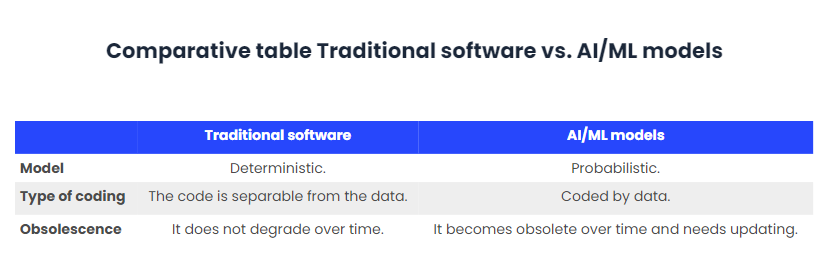
This means that models degrade and it is a prerequisite to continuously review the model to ensure that performance is not affected, which depends on the construction of the model, as well as the data generated by the model, periodic updates and restructuring after each update.
ModelOps works in a way that allows models to be managed and scaled to meet demand. Carry out continuous monitoring to detect and correct failures and deviations. As mentioned above, ModelOps is based on DevOps principles, but the latter technology is unsuitable for production models, as there are no concepts in it referring to software deprecation over time, which makes any production model require an update with new data collected.
Benefits of adopting ModelOps
ModelOps is designed to accelerate and improve the productivity of IT operations and analytics teams, regardless of the analytical language being used, the data being accessed or where the model will be deployed. This technology seeks to implement production models that include accessing data from a trusted source and maintaining privacy and security standards, thus avoiding the need to design a new model each time the process is updated. In this way, data lineage and tracking information for audit compliance is preserved.
Therefore, adopting ModelOps allows you to monitor the performance of putting in place an AI-based infrastructure. The above in conjunction with the ModelOps tools, results in transparency and understandability of AI that enhances trust in enterprise technology and digitisation.
Synchronisation of ModelOps and DevOps opens up new Opportunities
Data scientists use ModelOps while developers use DevOps. ModelOps is where data science meets production IT, generating business value. So, establishing ModelOps alongside DevOps can make injecting models into applications a leaner, high-performance process for any company.
Typically, production models have been implemented in a one-off manner, but application integration, model monitoring and tuning, i.e. the automation of such models is costly and time-consuming. This is why it makes sense to unite the development of models and applications in a data and intelligence platform where the information gathered through data can be exploited.
IBM MultiCloud ModelOps
IBM has brought to life Multicloud ModelOps, responsible for covering end-to-end lifecycles to optimise the use of models and applications across clouds. It is specifically designed for use in Machine Learning models, optimisation models and operational models. Multicloud ModelOps is intended to facilitate continuous integration and distribution (CI/CD).
Its ecosystem features technologies such as AutoAI, IBM Cloud Pak for Data that enable optimal implementation of ModelOps and DevOps, so that new models can be updated and implemented on a regular basis to adapt to the requirements and needs of different companies. AutoAI facilitates collaboration between the data science team, reducing the complexity of deploying and optimising models in production.
The main features of ModelOps Multicloud are:
- The ability to automatically acquire data, select models, perform feature engineering and optimise hyperparameters.
- Visualise model biases, learn how to mitigate them and explain the results.
- Generate model replacement, detecting data inconsistency causing the deviation.
- Process data before updating new models, handle errors and include model calls.
- Deploy and send models virtually anywhere.
- Create, run and manage models in a unified interface, along with continuous improvement of models using a feedback loop.Por otro lado, existen más productos en el mercado, es el caso de Lumen. Este producto es una plataforma que permite a los científicos de datos implementar modelos de manera más eficiente. Lumen aporta la automatización necesaria para agilizar el proceso de implementación.
This technology firmly negates the need for a team of developers once the platform is operational, as it can quickly deploy models in an automated way. This allows new existing models to be tested and updated and new use cases to be explored. Thus, the organisation is assured that the investment in data is producing high returns.
Conclusions
Companies that have machine learning models deployed in production need to keep up with the pace of updating them, so that they do not become obsolete and can keep up with market changes.
AI makes it possible to optimise models and learn when to use them in different conditions. In addition, there are currently many models for solving various business problems, and in today’s highly dynamic environment, the nature of the problems and the applicability of a particular model is constantly changing. Thanks to ModelOps it is no longer necessary to implement one by one updates to production models generated by these changes.
In conclusion, trying to become a true AI infrastructure-based organisation requires a comprehensive and efficient analysis capability. This places ModelOps at the centre of the market, which working together with DataOps and DevOps will lead to great performance and benefits.