How AI Is Revolutionizing the Supply Chain
.png)
 Daniel Valverde


Artificial intelligence (AI) is redefining supply chain management. From optimizing processes to cutting costs and boosting efficiency, AI is transforming how companies run their logistics operations. But not all AI is created equal. On one side, we have traditional AI—longtime ally in forecasting and analytics. On the other, we have emerging forces like generative AI, the Internet of Things (IoT), and Edge AI, which are poised to radically reshape supply chain software. Let’s break it down.
Traditional AI: The reliable backbone of the supply chain
Neural networks and machine learning have been powering supply chains for years. They’ve helped companies forecast demand with more variables, (some we never even thought to track), analyze real-time images, and instantly collect and interpret operational data. Here’s how:
- Smarter forecasting and planning
- Predictive analytics: AI blends historical data, market trends, and external events to deliver accurate demand forecasts, reducing overstock and stockouts.
- Machine learning models: Spot patterns in consumption, seasonality, and even weather changes to fine-tune production and distribution.
- Example: Amazon uses AI to forecast demand during Black Friday, fine-tuning its inventory in real time.
- Dynamic inventory management
- Real-time stock monitoring to flag slow-moving products or restocking needs.
- Automated inventory adjustments in response to demand changes or disruptions.
- Minimizes waste—especially for perishable goods.
- Example: Walmart uses AI to cut excess stock in its warehouses, saving millions annually.
- Logistics and transportation optimization
- AI algorithms evaluate traffic, fuel costs, and route restrictions to find the most efficient paths.
- Fleet monitoring and predictive maintenance reduce downtime.
- Example: DHL uses AI to optimize routes, saving fuel and speeding up deliveries.
- Intelligent supplier management
- Evaluates supplier performance—quality, compliance, costs—and recommends the best-fit partners.
- Predicts risks like geopolitical instability or natural disasters.
- Example: Unilever uses AI to diversify its supplier base and prevent supply chain disruptions.
- Warehouse automation
- AI-guided robots handle picking, packing, and sorting—faster and with fewer errors.
- Chatbots answer customer queries or process orders in real time.
- Example: Alibaba uses warehouse robots to process thousands of orders per hour.
- Sustainability at the core
- Optimizes routes and reduces waste to lower the carbon footprint.
- Improves energy efficiency in warehouses.
- Example: Nestlé uses AI to track and reduce emissions across its global supply chain.
Generative AI: The future is already here
Generative AI—capable of producing text, data, and simulations—is the supply chain’s rising star. While still maturing, its potential is massive.
Key impacts
- Advanced forecasting: Creates "what-if" scenarios to simulate disruptions (e.g., port closures) and suggest optimal responses.
- Document automation : Instantly generates contracts, purchase orders, and logistics reports—error-free.
- Network design: Recommends ideal warehouse locations or shipping routes based on cost and constraints.
- Risk management: Simulates supplier failures or geopolitical threats to prepare contingency plans.
- Example: Maersk uses generative AI to simulate alternative maritime routes and cut costs during port congestion.
What’s next
- Digital twins: Virtual replicas of supply chains for real-time simulations.
- Conversational assistants: Tools like ChatGPT or Grok will negotiate with suppliers or coordinate logistics using natural language.
- Hyper-personalization: Tailored supply strategies for each customer, improving delivery and reducing waste.
IoT: A hyperconnected supply chain
The Internet of Things (IoT) uses sensors and devices to deliver real-time data, giving companies full visibility across their supply chains. It’s like putting eyes and ears on every truck, container, and warehouse.
Key impacts
- Full visibility: Track location, temperature, and humidity for granular control.
- Predictive maintenance: Catch anomalies and prevent equipment failures before they happen.
- Live inventory tracking: Sensors keep tabs on stock levels to avoid shortages or overages.
- Traceability and compliance: Ensure sensitive products (like food or pharmaceuticals) meet regulatory standards.
- Example: Pfizer uses IoT to monitor vaccine temperatures in transit, ensuring product integrity.
What’s next
- 5G and massive IoT: Real-time connections across millions of devices for perfect coordination.
- IoT + Blockchain: Tamper-proof traceability, ideal for food and pharma sectors.
- Sustainability tracking: Monitor emissions in real time to enable greener routes and practices.
Edge AI: Smarter decisions at the source
Edge AI brings intelligence to the edge—processing data locally on sensors, cameras, and vehicles instead of relying on the cloud. That means faster responses, lower latency, and improved security.
Key impacts
- Autonomous decisions: Drones and smart vehicles can adjust routes in real time.
- Remote operations: Processes data on-site in places like cargo ships or rural warehouses.
- Real-time analysis: Cameras detect product defects instantly—no need to send data to the cloud.
- Lower costs: Reduces bandwidth and server usage.
- Example: Tesla’s Semi trucks use Edge AI to optimize routing based on traffic and weather conditions.
What’s next
- Autonomous robotics: Warehouse robots coordinated by Edge AI—no human input needed.
- Advanced security: Edge AI-enabled cameras detect hazards at logistics sites.
- 6G readiness: Ultra-low latency data processing at scale.
Synergies: A smarter, unified ecosystem
These technologies don’t operate in silos—they’re even more powerful together:
- IoT + Edge AI: Sensors collect data, Edge AI processes it instantly (e.g., adjusting a container’s temperature in real time).
- IoT + generative AI: IoT feeds real-world data into generative AI simulations to anticipate delays and disruptions.
- Edge AI + generative AI: Lightweight generative models make local decisions—like optimizing a truck’s cargo layout.
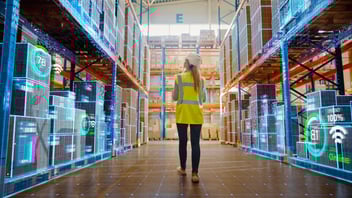
- Full-stack ecosystem: A smart warehouse monitors inventory via IoT, coordinates robots with Edge AI, and simulates demand scenarios using generative AI.
The challenges ahead
Of course, these innovations don’t come without obstacles:
- Privacy and security: Safeguarding sensitive data across global operations.
- Interoperability: Standardizing devices and platforms.
- Upfront investment: Cost of hardware, software, and training.
- Talent gaps: Growing need for professionals skilled in AI, IoT, and logistics.
Final take: The future is now
Generative AI, IoT, and Edge AI are propelling the supply chain into a new era. From digital twins and autonomous robots to real-time decision-making, these technologies are building supply chains that are faster, smarter, and more sustainable. Companies that embrace this wave early will gain a massive competitive edge—those that don’t risk falling behind in an increasingly volatile market.
Learn how Softtek and Blue Yonder are powering smart, next‑gen supply chains and connect with the Softtek team.
.png?width=352&name=ChatGPT%20Image%20Apr%2029%2c%202025%2c%2012_58_10%20PM%20(1).png)