 Kurt Nipp


The video game industry breeds excitement for all—for investors and publishers it’s lucrative, for consumers it’s entertainment, and for developers, it’s the passion and grit they pour into their games. But all this rides on the game “working as intended.” In this article, learn about game QA, why it matters, and the techniques and trends that go into publishing the perfect game.
What is game QA?
The goal of game quality assurance is to detect, record, and support fixing all technological or design issues in a video game. Four continuous activities (test planning, test suite creation, testing, and bug tracking) are continuously conducted in all game environments (development, staging, certification, and production) and throughout the whole game development process (from prototype to pre-release).
Game QA is high stakes
Game developers face routine challenges in fulfilling gameplay requirements. Modern games have a lot of content and simultaneous players and typically are made available on multiple devices. Considerable efforts are made to ensure product quality because several failures have occurred, even to the big game studios, due to inadequate quality in recent years. Now, testing must be faster, more efficient, and more accurate than ever.
QA is a critical part of the game company value chain because all stakeholders in the video game community have their rightful expectations:
- Gamers expect quality player experiences and will avoid games that do not support fairness, sustained awe, compelling storylines, and exhilarating gameplay. Most game franchises have player communities that ensure developers do their part to release quality user interfaces and games. Players see quality defects as evidence of shoddy products, and game reviewers and social media will often amplify the impact of products that fall short of market expectations.
- Game developers aspire to offer quality player experiences. Their goals are to enable functionality and audio-visual effects that the leading hardware devices can support. Game content is an art form where “performing as designed” is a key tenant. Based on game design, quality experiences are easier to support with solid and consistent game performance. This frees the game development teams to challenge the capabilities of game hardware without the burden of inefficient software, bugs, and lagging network performance.
- Investors are major budget enablers for game developers, and in return, they expect games to work as designed to get their returns.
- Advanced gameplay device operators, such as Sony, Microsoft, Nintendo, and Valve, curate the content in their gaming services and allow first- and third-party game developers to take full advantage of their hardware capabilities. Quality games enable these operators to increase revenue by ensuring player progression and satisfaction.
- Game publishers deliver greater financial returns with high-quality games and are fiercely protective of their brand reputations, which could be at stake if a single buggy release occurs.
What's included in the scope of game QA?
Game QA can be applied to every aspect of a game, including but not limited to:
- Gameplay: ensures that a game is engaging and true to its IP. QA objectively reviews player interactions with games to ensure an exhilarating player experience.
- User interface: clear navigation, user journey, and graphical interface performance.
- Game responsiveness: fast and accurate response to player inputs. This depends on several factors, including network latency, response to game controls, rendering frames per second, data gravity, and graphic hardware performance.
- Game economy: the economy is balanced, and player activities are rewarded commensurate with level, skill, and effort. In-game item pricing supports the game’s value proposition.
- Localization: audio, subtitles, chat, text in-game art, currency, customs, and date format is consistent with the intended country and/or language.
- Load performance: latency and responsiveness remain in acceptable ranges when increasing the number of concurrent users or transactions per second.
- Game efficiency: optimizes resource consumption on the game servers, streaming devices, and player-side thin clients – battery, memory, disk, CPU, and network.
- Functionality is enabled with working menus, movement controls, networks, special effects, and visual effects.
- Exploits are identified and always addressed, either by the QA teams themselves or by hardcore gaming customers.
- Compatibility with various game platforms, operating systems, and devices (including mobile) is ensured.
- Regulatory compliance with industry or country standards on data security, child access, physical access, screen access, and quality.
- Cloud gaming fitness, including latency, player-side performance, data gravity, etc., is supported.
- Security: includes effective protection of player data, digital wallets, player accounts, digital identities, and entitlement systems. Testing also validates that the game code base has been hardened to address security vulnerabilities and withstand hacking and cheating efforts.
- Logging: multiple logs support accurate security tracing and performance troubleshooting
- Interoperability: cross-play and avatar portability between games is tested when required.
- Image recognition: successful analysis of display size issues regarding graphics and screen content.
- Graphics: ensure an immersive game experience powered by responsive animations, photo-real graphics, pictures, and other visual effects.
- Audio: ensures that game audio powers game immersion and is paired with visual content.
Designing quality into the game: during or after development?
While no game is perfect in every way when first developed, game developers employ several methodologies to ensure that prototyping, storyboarding, development, and testing support consistently high quality during game development. QA embedded into a lean Agile team is a leading approach to continuous quality game development. Waterfall-based testing can also be employed prior to game release by testing the overall player experience.
QA techniques
QA uses many techniques and processes to ensure quality code, summarized by the survey responses below. Automated QA (65%) and code review/inspection (54%) are the most popular testing methods employed by QA with a large variation:
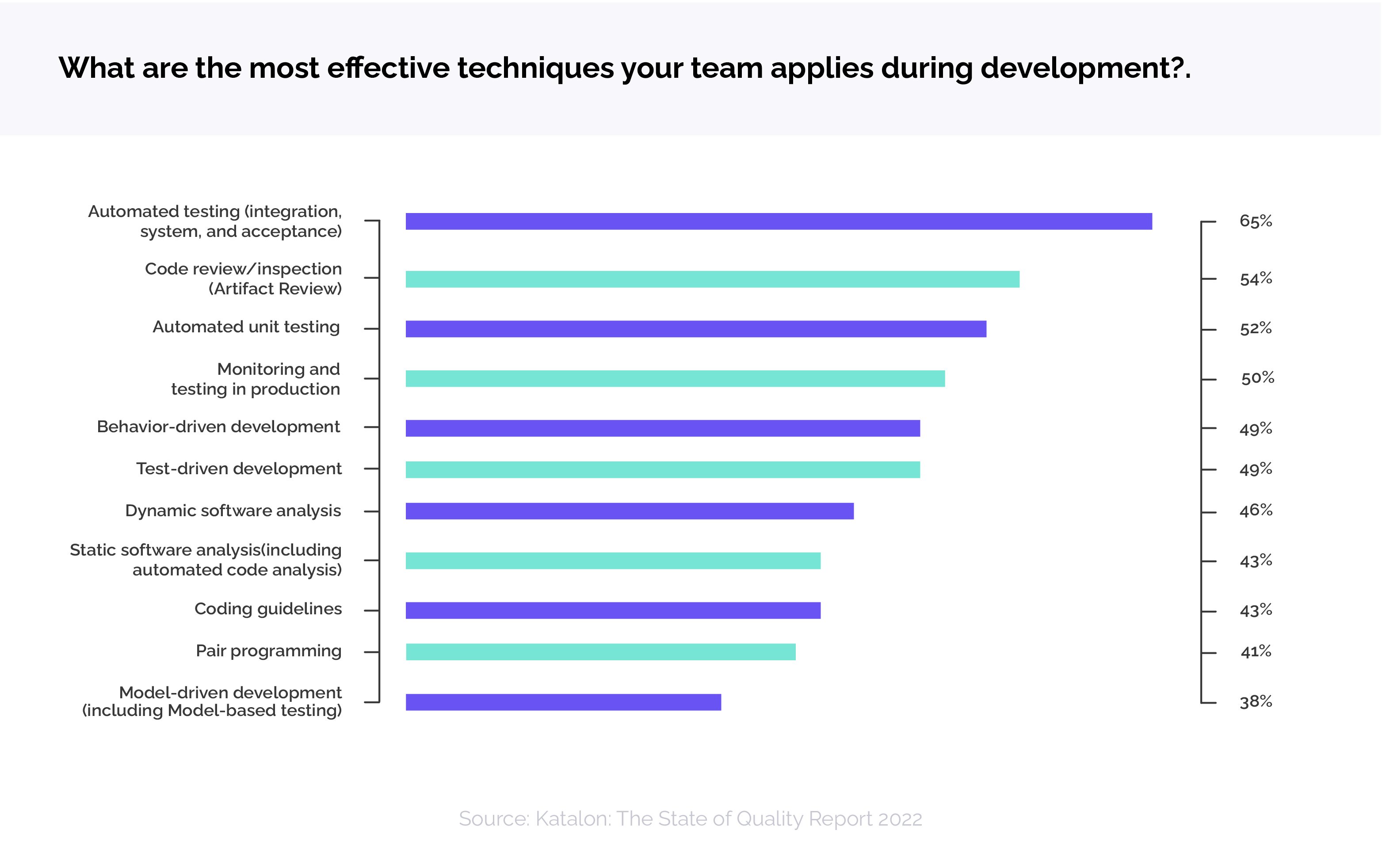
Other popular QA techniques include test-driven development (49%), behavior-driven development (49%), and static software analysis (43%). Most teams perform manual testing in addition to utilizing the tools above primarily because game QA testing is often difficult to automate.
Game QA trends for 2022
QA practitioners are adapting their processes to benefit from several advancements, including:
- Artificial intelligence and machine learning
- AI-based machine learning tools are becoming more readily available to teams to assist QA with identifying the most effective test suites, test automation, and test performance, as well as the risks inherent with the associated methodologies based on prior experience.
- Agile-based DevOps methods
- With DevOps practices, testing occurs throughout the CI/CD cycle. These methodologies enable QA to perform continuous testing at higher velocities than ever before. The embedded QA professionals adjust the test configuration, execute scriptless test automation, and address test case scope, which enables early testing and reduces rework.
- Availability of AR and VR in games
- QA is a critical contributor to the growth of both AR and VR. There are several key differences between AR/VR testing and traditional console, PC, and mobile-based QA. Physical space, ambient light, motion sickness, and documentation challenges are unique to QA for AR and VR.
- Growing emphasis on user experience
- With the growth of self-service interfaces within in-game portals and in-game stores, user experience is a critical driver of customer adoption and satisfaction. The user interfaces should be intuitive and easy to navigate.
- QA tools automation
- Current trends in QA automation have led to dramatic improvements in the time, resources, accuracy, and scope of QA testing. Before automation, QA testing was often crowdsourced, with most of the testers participating toward the end of the development phase. With automation, testing is possible throughout the development cycle thanks to having QA resources embedded in the Agile teams.
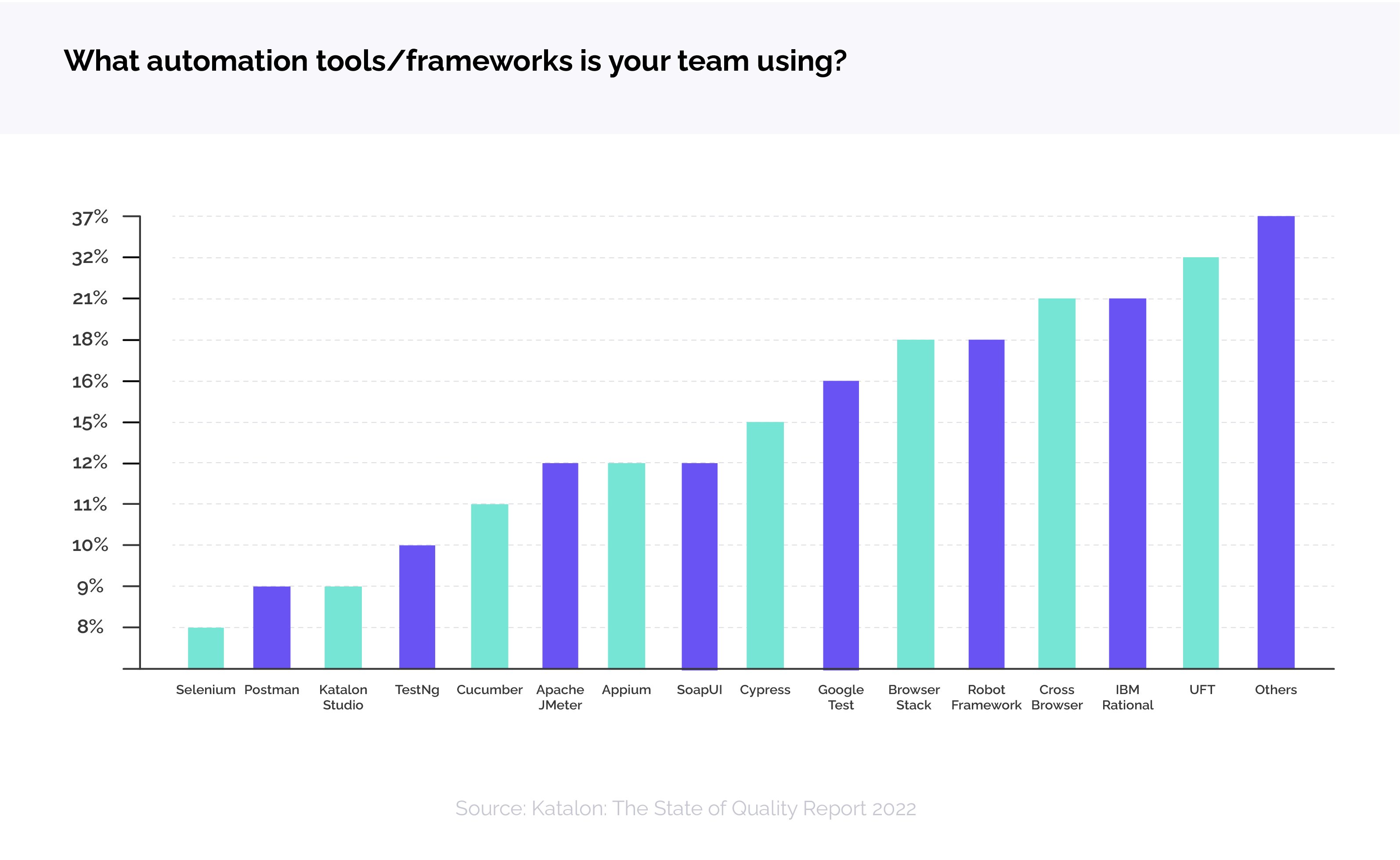
Game QA organizations have a large variety of testing automation frameworks to choose from, summarized by the survey responses below:
- Expanded scope of QA responsibilities in leading environments
- QA testing has evolved into QA engineering in many leading organizations. In addition to executing test scripts, QA is increasingly focusing on various areas of system performance, including user experience, hardware, software, operating systems, and configurations to verify game functionality. This increase in scope amplifies the impact game QA can have on player satisfaction.
- Social media's role in QA
- Even with a large amount of QA effort on video games, players are constantly testing games during gameplay before and after launch. Players are glad to support developers (especially during alphas and betas), given good communications on feedback loops that allow bugs or known issues to be acknowledged, recreated, and fixed efficiently. Players and QA engineers use game forums and external social media (e.g., Discord, Twitter, TikTok, Twitch, Reddit) to ensure that player expectations are managed throughout their gameplay experiences.
- Multiplayer game growth
- Most of the games developed in the early days of video gaming were single-player or single-console multiplayer. These games were straightforward to test because of design limitations. The recent growth of new game designs and game engine features have enabled multiplayer game offerings, including MMORPGs, battle royale, and open-world genres. QA has more complex methodologies to account for the interaction of players with their environments and one another. This development increases the QA efforts and reduces timeframes to ensure quality player experiences.
The critical role of QA in publishing the perfect game
Video games have become infinitely more complex than their 8-bit predecessors, and now all stakeholders—gamers, developers, investors, publishers, device operators, and more—depend on game QA more than ever to meet their rightful expectations.
Connect with Carlos Valerio on LinkedIn to learn more about Softtek’s Game QA offer.