 Dan Berthiaume


Users of outsourcing and shared services for finance and accounting functions are increasingly choosing to travel along one of two divergent roads, with the relative maturity of their service delivery organization playing an important role in which road they choose. Initial results of the Everest Group/SSON Vertical Industry-specific Strategies for Shared Services and Outsourcing (VISSSO) survey show that mature organizations prefer an end-to-end finance and accounting outsourcing (FAO) model, while less mature organizations tend to focus on creating ongoing change with a best-of-breed or point approach.
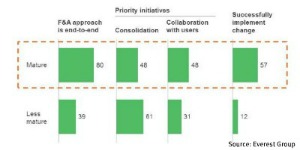
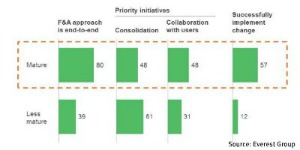 Looking at the data more closely, a striking 80% of mature FAO organizations use an end-to-end approach, double the 39% of less mature organizations who do so. Interestingly, less mature organizations are much more likely to consider consolidation a priority FAO initiative (61%) than mature organizations (48%), while mature organizations are much more likely to rank collaboration with end users as a priority initiative (48% to 31%). Furthermore, mature organizations are almost five times as likely to say they have successfully implemented change (57% to 12%).
The last figure may actually be the most telling about the reasons behind this divergence of FAO philosophies. For mature organizations to feel they have already successfully implemented change in their F&A processes at much higher levels is not especially surprising – they have been at it longer and had more opportunity to make and learn from their mistakes and perform the experimentation necessary to fine-tune their efforts.
FAO is also among the most mature BPO areas, meaning mature organizations may have been engaging in FAO for 15 years or even longer. They have had time to extend outsourcing throughout their F&A organizations and are more interested in collaborating with their user groups than in finding new ways to consolidate operations and generate additional change.
Turning our focus on less mature FAO organizations, we find that only about one in eight feels they have successfully implemented change. While some of this reticence to declare success is undoubtedly related to the shorter period of time they have been performing FAO, some also relates to a shift in the general approach toward outsourcing. Namely, in recent years companies have been shying away from large, all-inclusive outsourcing rollouts and instead focusing on smaller, point deployments of BPO.
Commentary from several expert sources backs this premise up. For example, according to the 2011 ISG TPI Index, the number of global BPO contracts worth $25 million to $99 million grew from 212 in 2010 to 663 in 2011, while the number worth $100 million to $999 million only grew from 149 to 197 and the number worth $1 billion or more actually declined from 16 to 10.
In addition, management consulting firm Swingtide reports a noticeable uptick in outsourcing deals worth $15 million or less among its clients, and a November 2011 blog entry from UK-based outsourcing advisory firm Burnt Oak Partners states large outsourcing deals have “all but disappeared,” while today’s deals are “smaller, shorter and less complex” than those of three to five years ago.
Beyond saving upfront costs (although Swingtide and Burnt Oak both warn of problems associated with smaller outsourcing deals that include prohibitive transition costs and difficulties in managing multiple vendors), these deals more easily enable end users to pursue a strategy of continual change and improvement, in a sense negating the whole concept of final, “successful” change.
Poet Robert Frost famously wrote “two roads diverged in a wood, and I took the one less traveled by, and that has made all the difference.” Despite its growing popularity, the road to FAO based on continual change and multiple, smaller deals is the one less traveled by, but it is not necessarily superior. Organizations developing or modifying an FAO strategy need to consider factors such as size and maturity of their organization, corporate culture, short- and long-term goals, and time and resources available to commit to outsourcing efforts when determining which road to take.
Ultimately the road to FAO success is the one with the fewest detours, straightest path, least amount of obstacles and clearest destination.