Outsourcing Software Development? Choose a GenAI-Enabled Partner.
 Benjamin Burke


Introduction: Modern enterprises run on software. But how you build it matters more than ever.
Every company today is a software company, whether they mean to be or not. Even organizations whose core products aren’t digital—like restaurant franchises, healthcare networks, or airlines—are solving critical problems with code.
As demand for digital solutions accelerates, so does the pressure to optimize your development engine: what gets built, how fast, and at what cost.
For decades, labor arbitrage helped ease those pressures. By outsourcing software development, businesses could stretch budgets, reduce time to market, and expand delivery capacity beyond internal limits.
But even labor arbitrage has its limits. Technology arbitrage is the next lever—scaling output through tools like GenAI, not just people.
What is technology arbitrage?
Technology arbitrage is the use of technology to increase output without increasing headcount. Instead of scaling through people, organizations scale through tools—most notably artificial intelligence (AI) and automation.
But not every organization is equipped to build, train, or orchestrate AI tools themselves. That’s why a growing number are turning to delivery partners who already use AI to work smarter, faster, and more efficiently.
For many of these companies, outsourcing is the most practical way to access the benefits of AI without the cost and complexity of building it in-house. But “AI outsourcing” can take many forms—depending on your goals, capabilities, and where you are in your AI journey.
Three types of AI outsourcing
Below are three common models organizations use to bring AI into their business through outsourcing:
1. Outsourcing the development of AI (AI as the deliverable)
You hire external AI development partners to build or enhance AI systems:
- Custom AI/ML model development
- Training or fine-tuning foundation models
- Building copilots or AI-powered features for internal users or customers
- AI integration with enterprise systems
- AI strategy and consulting
Goal: Embed AI into your business operations or customer experience.
2. Outsourcing for AI operations or data services (AI as the process)
Partners support the ongoing operation of your AI systems:
- Data annotation, curation, and labeling
- Prompt engineering or tuning
- Synthetic data generation
- Model monitoring and retraining
- Reinforcement learning with human feedback (RLHF)
Goal: Support and sustain your internal AI initiatives at scale.
3. Outsourcing to partners that use AI (AI as the enabler)
Your outsourcing partner uses AI to improve their delivery to you:
- GenAI-augmented software development
- AI-assisted testing and QA
- IT service automation (ITSM/AMS)
- RPA and intelligent BPO operations
- Human-in-the-loop workflows
Goal: Benefit from AI-enabled delivery without owning the tools, training, or infrastructure.
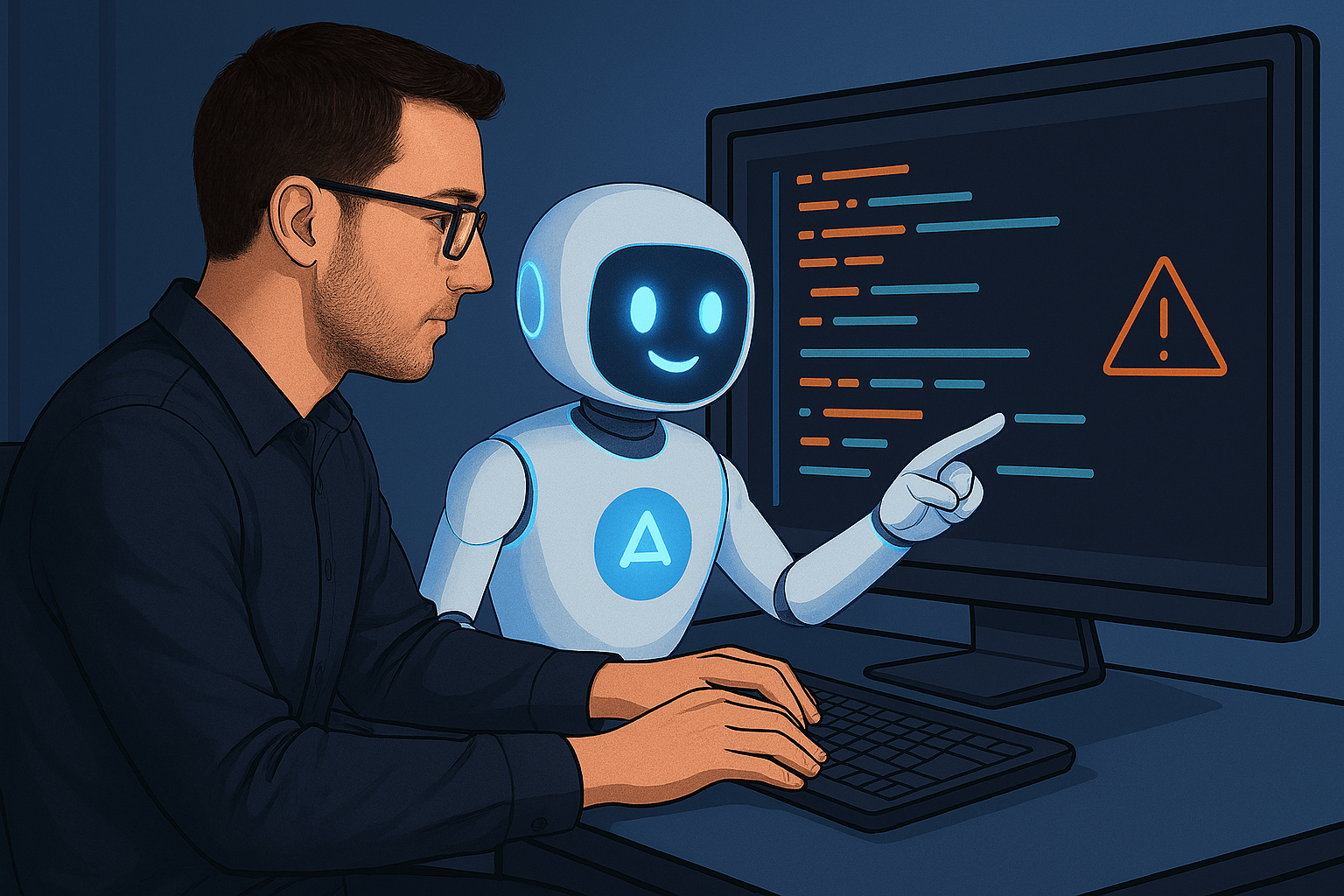
This article focuses on the third model: working with development partners who use AI to enhance their delivery to you.
What to know about AI-driven software development outsourcing
No matter where you are on your AI journey, one thing remains true: your software still needs to get built. And if you’re already outsourcing some of that work, there’s a simpler, lower-risk way to get more value from your outsourcing investment.
The easiest way to benefit from GenAI? Partner with those already using it.
Software-engineering and IT-operations vendors have raced to embed large-language-model (LLM) tooling, code copilots, and AIOps platforms into their global delivery centers. This helps clients benefit without the risk, ramp-up, or internal change management associated with building and managing in-house AI capabilities.
Here’s what that can look like:
- Requirements get transformed into detailed stories, epics, and test cases
- Mockups generate front-end code in minutes
- Repetitive tasks—refactoring, regex, documentation—are AI-assisted
- Test cases are generated with coverage gaps flagged
- Risk-based regression testing is automated
- Large-scale code changes are mapped, migrated, and explained with AI support
Why it works: Outcomes over investment
- No adoption burden: Skip tools, licenses, and culture change—just get results.
- More value, same contract: GenAI-enhanced teams deliver more, faster.
- Fewer tradeoffs on scope and quality: AI tools reduce the friction of doing things right—so teams don’t have to choose between speed and standards.
- Happier teams: Less tedious work leads to more engagement.
What changes when AI is embedded in delivery?
At Softtek, we’ve embedded GenAI accelerators across the SDLC—and the biggest impacts often aren’t what clients expect:
- Backlogs stop being a burden. With faster throughput, clients stop asking how to clear the backlog—and start asking what’s worth adding to it.
- Improvements stop being tradeoffs. Teams say yes to enhancements that once felt too expensive or too time-consuming.
- Delivery conversations shift. It’s no longer just about speed or savings. It’s about unlocking more value from every sprint, every cycle, and every contract.
Why this matters now
Software engineering is already one of the most commonly outsourced functions. But the game is changing.
GenAI is now a core driver of delivery productivity. The most effective partners are those who have already embedded it across their SDLC, DevOps, and engineering workflows.
That means you don’t need to invest in AI tools or training to reap the benefits. You don’t need to place a bet or take on risk. You just need to pick a partner who uses the right tools to deliver the right outcomes.
What to look for in an outsourcing partner that uses GenAI for development
Proven delivery
Proven delivery. Look for delivery partners with real, tested GenAI accelerators embedded across the SDLC—not just pitch decks or POCs. Ask how their tools work in production environments, what results they’ve delivered, and how often they’re used across client projects.
Red flag: AI capabilities that live in a slideshow, not in your workflow.
Works with your SDLC
AI adoption shouldn't mean process disruption. The best partners embed AI into the tools and workflows your teams already use—whether it's Jira, Git, Figma, or Excel—and can plug into your Agile or DevOps model without friction.
Bonus: Accelerators and agents that require no new licenses, logins, or steep learning curves.
AI with transparency and human-in-the-loop
Your teams should be able to review, edit, and approve any AI-generated artifact. Enterprise-grade delivery thrives on explainability and governance, not just outputs.
Ask the service provider: How much control do teams have over AI outputs?
Comprehensive AI over single use cases
True delivery transformation means improving not just how you build software, but how you manage, test, deploy, and maintain it. Look for partners whose AI capabilities extend into areas like testing, deployment, documentation, and large-scale code changes.
Reflect on this: How many AI-delivery-enabled service providers do I really want to manage?
Implications for your sourcing strategy
So what does all this mean when you’re evaluating partners?
- Prioritize outcome-based contracts. When GenAI compresses effort hours, value shifts from rate cards to real results—like story points delivered, mean time to resolve (MTTR), or conversion funnel lift.
- Expect governance to be built in. Leading partners bundle explainability frameworks, bias checks, and prompt libraries—practical guardrails that protect productivity and reduce risk.
- Validate claims with proof. Use analyst rankings to shortlist GenAI leaders, then test their delivery with a bounded pilot on your live backlog.
- Plan ahead for talent redeployment. With routine coding and monitoring handled by AI, your retained teams can focus on architecture, product discovery, and FinOps oversight of your AI pipelines.
Conclusion: AI-enabled delivery is the new baseline in development outsourcing
AI-enhanced development is quickly becoming one of the most practical and proven applications of AI in the enterprise. And for organizations already outsourcing parts of the SDLC, choosing a partner with AI-enabled service delivery isn’t a bold move—it’s just a smarter default.
Software engineering partners like Softtek already use GenAI across the SDLC —accelerating delivery, raising quality, and freeing up internal teams. Clients aren’t increasing budgets or cutting corners. They’re simply unlocking more outcomes from the outsourcing investments they’ve already made.
If you’re tired of chasing the tooling arms race, rolling out copilots before you’re ready, or absorbing the cost of proprietary AI initiatives, remember: that’s not the only way to win.
You don’t have to build AI to benefit from it. You just need a partner that already does.
AI is redefining software development outsourcing. But how you outsource can have just as much impact.
Explore the nearshore model—and what it could mean for your delivery strategy—in our Nearshore 101 guide.