
 Softtek


The world of the Customer Experience (CX) and digital channel shopping is constantly changing, and the arrival of the COVID-19 is causing everything to accelerate and the changes that are occurring on the Customer Journey to be forever. Consumers are getting used to consuming content, making purchases and meeting their needs immediately and through different touchpoints, channels and devices.
From IoT devices to applications, brands are struggling to keep up with the demands and needs of customers, and customers are increasingly adopting technologies such as IoT to meet their needs, although many brands have not yet done so.
Brands that keep pace with this trend are reaping the rewards, while others are racking their brains wondering how they can ride the wave without having to invent their own IoT device or create back-end solutions from scratch. The answer to this is in Headless Commerce.
Headless commerce: the most flexible and agile solution
With the Headless Commerce, companies aim to respond to changing customer demands in a faster, more flexible and agile manner. This term is probably one of the most widely used in e-commerce today, but at the same time, it is one of the least understood.
This new approach separates the front-end layer of the back-end layer in an e-commerce platform behaving each part independently. The front-end of the platform acts as an intermediary channel between the user and the e-commerce portal, while the back-end manages the details of the product and the entire operation of the portal. Over the years, e-commerce platforms have been following a classic approach in which the front-end and back-end are controlled from the same panel, which means they share a common platform, but also restricts customisation of the trade, prolongs implementation times and creates problems in adopting technologies to expand into new channels.
For a while this approach proved more than sufficient to meet the needs of consumers at the time. But now with the proliferation of computers, social networks, smartphones, smart clocks, IoT, etc, platforms with this classic approach have found themselves in a reality for which they were not prepared.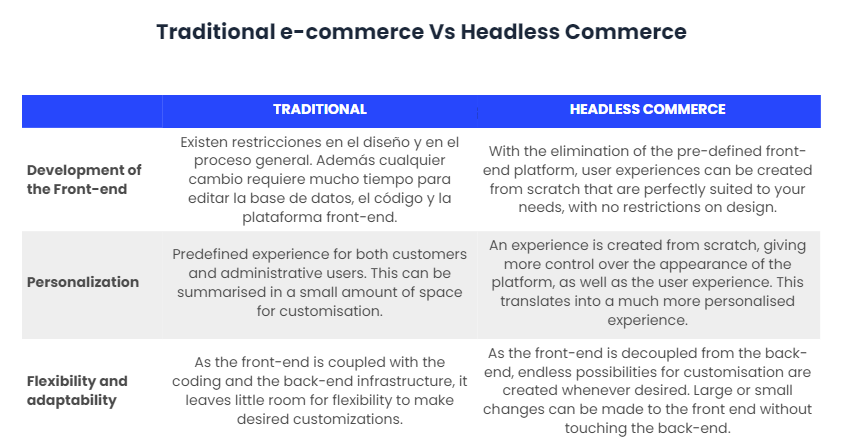
The modern era of e-commerce has introduced challenges that classic e-commerce solutions are finding increasingly difficult to meet due to their operational limitations. With Headless Commerce this disappears, as the front-end part is separated (usually templates or themes) leaving only the back-end. Developers can then use APIs to make product deliveries, blog posts or customer reviews on any screen or device.
APIs function as a flexible communications layer that transmits information between the front and back of an e-commerce portal. With APIs, developers can enable the creation of multiple front-end applications that access the features and data of an operating system, application and other service.
Why is it necessary now?
All that flexibility means that the Headless Commerce architecture is designed for the IoT era, plus it reduces or even eliminates the creative customisation constraints imposed by integrated front-end and back-end systems. Using APIs to deliver services between the two halves (front and back) enhances the flexibility to drive a wide range of multi-channel scenarios.
With a Headless Commerce approach developers can enable e-commerce with any system, application, or IoT device, such as smartwatches, digital kiosks, smart appliances, smart speaker skills like Google or Alexa, and integrate seamlessly with other content management systems.
With all this we can say that there have been some factors that have contributed to the boom of Headless Commerce:
- Increased customer expectations: We live in an era of convenience, especially for consumers. Customers expect to be able to find and buy products with just a few clicks. This puts pressure on brands to deliver the experience customers are looking for on any shopping platform and as quickly as possible. Headless Commerce helps to achieve this.
- More sales channels than ever before: As we have already mentioned, there are now a huge number of channels through which a retailer can offer its products, and consumers have gone from using the same channels (which used to be one or two) to wanting to use virtually all of them. Trying to reach all possible sales channels that consumers are currently using can be a headache for brands. With Headless Commerce brands can reach all those different channels.
- The competition is growing: All e-commerce retailers know that online sales are quite a competitive space. Since online sales started to grow, more and more brands want to sell their products through these channels. In order to stay ahead of the competition, new technologies must be adopted as quickly as possible. A Headless Commerce architecture provides the necessary flexibility to achieve this.
Beneficios clave del Comercio sin Cabeza
There is a misconception that if you separate the front end from the back end the results will be less pleasant, but that is not the case with Headless Commerce. With Headless, the separation of front and back-end creates a faster API-based approach to web development, offering competitive benefits ranging from more accelerated marketing initiatives to true omnibus experiences.
- Completely omnicanal: Headless Commerce helps drive content on any platform, anywhere. For a brand that means delivering its products, product videos or blog posts on any channel that has emerged or will emerge. With this approach, selling through Alexa, digital signage, social networks, progressive web applications (PWA), wearables and even through display coolers is entirely possible.
- Always up-to-date: With a Headless Commerce platform the brand can implement updates quickly and without affecting the back-end system. In addition, any changes to the interface can be made to coincide with the constant advances in consumer technologies, making the brand competitive. For example, brands using a more traditional e-commerce platform often implement updates every few weeks. A company like Amazon implements updates every 11.7 seconds.
- Agile marketing: In Headless Commerce system can support new technologies as they emerge. This is perfect for the marketing team to design new customer experiences. In addition, thanks to the flexibility provided by this system, marketing teams can set up a new site in days instead of months.
- More personalised and consistent customer experience: Customer data is available on all touchpoints, enabling salespeople to deliver relevant products and offers to customers, and to create personalised and meaningful shopping experiences.
- Easy integration with other platforms: A Headless Commerce solution must have an API, which facilitates integration and communication with other platforms. A brand can be integrated into any new device that appears, expanding its opportunities and reaching more customers at the same time. Furthermore, this integration will not take months, but hours.
- Scale faster: Without operational restrictions, developers can work more efficiently, reducing operational costs and accelerating site updates in less time and using fewer resources.
- Maximize conversions: Brands switching from traditional e-commerce to Headless Commerce often get more conversions. In fact, those who adopt this approach often see an average increase in conversion rates of 15% to 30%.
- Higher level of security: Headless Commerce also offers a higher level of security, aspects which are often lacking in a traditional system. The API used to provide content is often more impervious to threats than other software systems.
Amazon is at the forefront in demonstrating the true value of incorporating a Headless Commerce platform, and how this can help retailers avoid experiencing the frustration often associated with the more traditional approach. Nike, on the other hand, has increased its conversion rate from 15% to 30% since implementing a Headless Commerce system. Venus Fashion also implemented this system and reduced the average loading time of its mobile website to 320 milliseconds, increasing the page loading speed from 15% to 73%. Target is another leader in e-commerce in the U.S. who adopted Headless Commerce to reduce bounce rates and a higher return on investment for SEM.
Challenges of Headless Commerce
However, like any other tool the Headless Commerce is not perfect. These are some of the challenges that must be met:
- Ongoing costs: One of the biggest drawbacks of Headless Commerce is that because an interface is no longer provided, developers will have to create one for the retailer. This requires time and money.
- Implementation takes time: Because it has to be created from scratch, implementing a Headless Commerce system takes more time. However, it is possible to find suppliers who can do this implementation more quickly.
- It can be complex: Although it is a flexible and adaptable system, it is precisely these qualities that make it a complex system if it is not well understood. For this reason, you may have to rely on developers to make changes to the system.
All these drawbacks can make a retailer wonder if a Headless Commerce architecture is right for their business at this time. It is not always easy to know, but what is clear is that if you want to have a better all-channel strategy, sell in several sites, and want to merge an e-commerce platform with another content creation platform, Headless Commerce is the best way to achieve this.
Conclusions
E-commerce is heading in an exciting direction. Not only does it make it possible for any brand, of any size, to be successful, but it has never been easier and more creative to create a website that captivates consumers.
Headless Commerce is leading the charge. This is a huge leap for brands looking to continually improve their shops, separating the front end from the back end, so that they can make changes without interrupting the customer experience.
By considering this strategy as a viable commercial approach, it helps to consider the future. As headless technologies mature, and technology take-up increases for retailers, they can move at a faster pace to adapt to the maturity of their business and the market.
Connected devices and new touchpoints are taking hold of markets and with all this explosive growth, retailers need to think strategically about how to access all these different channels, while at the same time delivering high quality, seamless experiences to their customers.
Headless Commerce offers a new standard of flexibility, adaptability and customisation that can be quickly realised as needed to achieve the goal of improving the customer experience. If you have not yet explored a Headless solution, it is time to see what you have been missing out on and why it is the e-commerce innovation everyone is talking about.