
 Softtek


The improved development of Artificial Intelligence (AI), Machine Learning and other related concepts has led to an increase in Intelligent Process Automation (IPA).
Intelligent process automation allows organizations to automate tasks that involve decision making, an activity that normally requires human intervention. In addition, it can effectively handle unstructured content, including text and images.
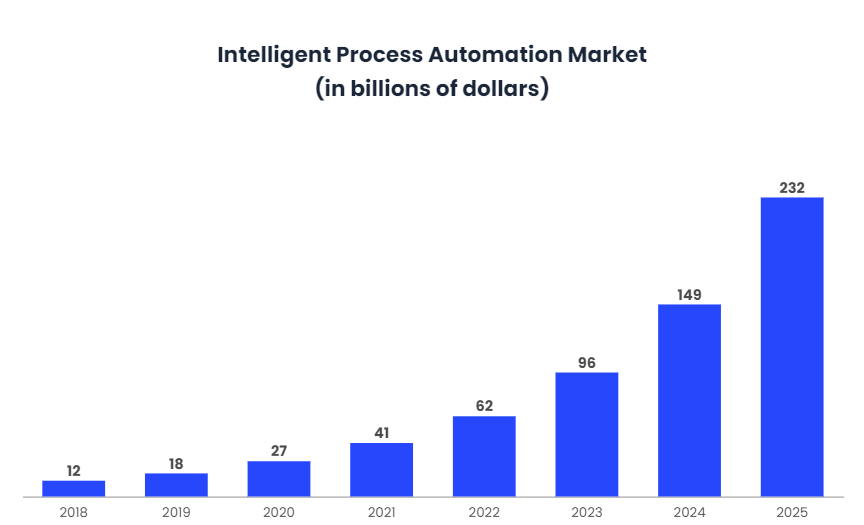
Advances in Cognitive Automation and computer vision are expected to stimulate the Intelligent Process Automation market. The business investment in Intelligent Process Automation and similar technology is expected to reach $232 billion by 2025, compared to $12 billion today.
What does intelligent process automation offer?
Before implementing virtually any new software or service, companies should have a clear understanding of the potential benefits to determine whether the return on investment will make the project worthwhile.
IPA tools are designed to be used by business people, frontline people who understand the company’s processes and desired results.
- Automation of workflows involving data extraction and normalization:
Converting unstructured content, such as text and images, into a structured format necessary for subsequent tasks.
For example, in the insurance industry, various companies can use IPA solutions to automate the processing of new claims, ensuring that they are correctly classified and sent to the appropriate subject matter expert for further review.
- Automation of manual tasks that require human decision making:
Offering the ability to make processes more scalable. They also help to improve accuracy, reducing risk by eliminating the possibility of containing human errors.
- Extraction of relevant unstructured data from emails, PDF files and other documents:
Converting that data into a standardized format that can then be sent to the company’s financial management system. Eliminating thousands of hours of tedious, manual, and often error-prone data processing.
Thanks to the introduction of these tools, companies can reduce process cycle times by 85% and increase process capacity by 4 times, allowing companies to scale dramatically without increasing the number of employees. Eliminating repetitive employee tasks also increases job satisfaction by freeing workers for more meaningful and rewarding work.
Which sectors would benefit most?
Once the benefits of this technology have been defined, it is important to show in which areas it will offer its greatest advantages. IPA tools are based on the concept of learning transfer, where a model trained in one task is used for another related task.
Intelligent automation tools can be applied to all types of use cases involving document-based workflows. Such as banks with their detailed processes for evaluating and approving mortgages, including data extraction and image recognition.
Or as discussed above, the analysis of insurance claims, where IPA solutions can quickly examine hundreds of requests and identify those that may be fraud.
However, such process automation solutions face two major limitations:
- They work only if the rules accurately capture the problem to be solved (similar to RPA). If any element involved in the process deviates from the predefined rules, the automation decomposes.
- This is a costly approach, requiring the company to hire full-time information architects to build and maintain the rules or to delegate this work to a third party.
While the full range of benefits comes from implementing the full set of IPAs, companies can quickly unlock significant value through individual elements.
The creation of an unsupervised Machine Learning platform along with a natural language generation engine, for example, will soon enable the processing of structured daily performance data to create insight that helps leaders make better decisions, while changing internal management processes at the same time.
Individual elements that can be part of IPA tools include Robotic Process Automation (RPA), Intelligent Workflow, Machine Learning, Natural Language Generation (NLG), and Cognitive Agents.
Conclusions
IPA is a form of Artificial Intelligence technology that employs Deep Learning technology to automate processes involving unstructured data. It is a major step in the evolution of AI and intelligent automation technology.
It’s time to start implementing this technology, because as spending and adoption increases, it will mean that more and more companies are improving their processes thanks to IPA, including competitors.
When a company has identified the need to adopt IPA tools, it is important to move quickly. Whichever company improves productivity through automation in the first place, it will have a competitive advantage, known as the “first automator advantage.