%20(1).jpg)
 Cristian Peñaloza


If you’re a supplier or raw material producer in a supply chain, you may have noticed excessive inventory piling up in your warehouses—even when your logistics operations seem to be running smoothly. If this sounds familiar, you might be experiencing the bullwhip effect.
What is the bullwhip effect?
Imagine this scenario: A retailer, such as a grocery store, relies on historical sales data to forecast demand for a specific product in the upcoming period. Based on this forecast, the retailer places their orders. The accuracy of that forecast can be influenced by seasonal trends, economic conditions, trade agreements, among other factors.
This initial demand estimate sets off a chain reaction. The less accurate the estimate, the greater the gap between supply and demand, amplifying variability as it cascades through the supply chain. The farther an actor is from the end consumer, the more significant this variability becomes. This phenomenon is known as the bullwhip effect.
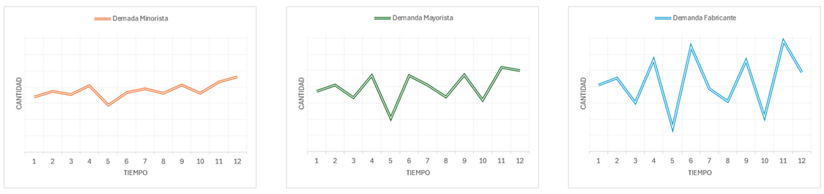
The image above depicts how demand fluctuations seen by a manufacturer (right chart) are often far greater than those experienced by a retailer (left chart). Wholesalers (middle chart), in turn, experience something in between.
The Beer Game: A case study of supply chain dynamics
The bullwhip effect was first studied in the 1960s at the Massachusetts Institute of Technology (MIT). Jay Forrester, a pioneer in system dynamics, developed a simulation exercise to illustrate how supply chains operate under real-world conditions. The exercise, known as The Beer Game, is still used today to teach supply chain management principles.
Participants in the game take on roles representing different parts of a supply chain—retailer, wholesaler, distributor, and factory. Each player manages their inventory independently, making decisions about how much to order, ship, or produce. The game highlights the challenges of maintaining inventory levels while responding to fluctuating demand, especially for manufacturers at the end of the chain.
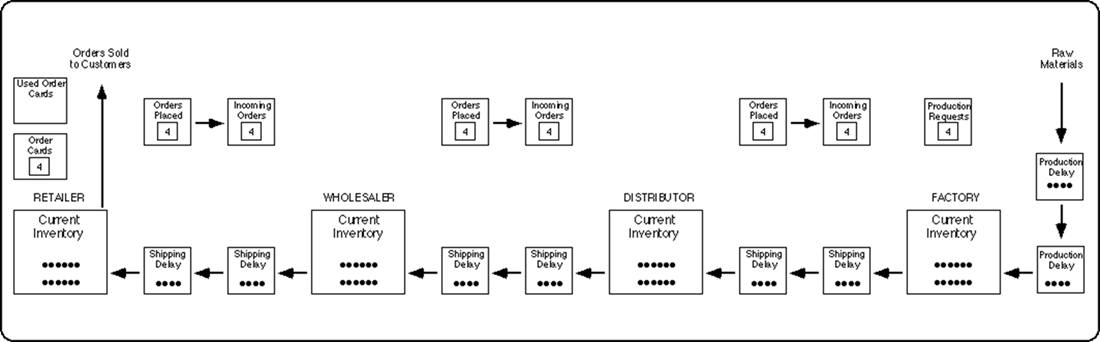
The Beer Game demonstrates how isolated decision-making, lack of communication, and limited information sharing can disrupt the entire supply chain, leading to inefficiencies and potential chaos. It’s become a classic teaching tool in process and industrial engineering programs.
Consequences of the bullwhip effect
The bullwhip effect can have far-reaching consequences for every actor in the supply chain. Here are some of the most significant impacts:
- Fluctuations in production: As demand estimates become more inaccurate further along the chain, production volumes and cycles become increasingly volatile. This variability can lead to inefficiencies, uncertainty in scheduling downtime, higher maintenance costs, and additional setup times.
- Excess or insufficient inventory: Retailers often add safety stock to buffer against variability in demand. This buffer is passed up the chain, with each actor adding their own safety stock, which can lead to overstocking. For example, when demand drops below expectations, excess inventory builds up at every level of the chain, increasing storage costs. Conversely, unexpected demand spikes can result in stockouts and delays in production.
- Increased costs: The most obvious costs are tied to excess inventory—storage fees, spoilage risks, insurance, and more. But other costs also rise, including logistics, distribution, planning, and the opportunity cost of lost sales. Adjustments to production schedules and inventory levels to meet fluctuating demand can add to the burden.
- Loss of reliability: Service levels suffer when stockouts occur, restocking is delayed, or product quality suffers. This can lead to dissatisfied customers, reduced sales, and broken supplier agreements.
- Persistent demand forecasting errors: Without refining demand forecasts, inaccuracies will continue to cause fluctuations. These issues are compounded by variable lead times for production, delivery, and raw material procurement.
The critical role of communication
When each actor in a supply chain independently forecasts demand, distortions in information amplify variability. Poor communication leads to decisions based on incomplete, outdated, or biased data, exacerbating the bullwhip effect.
To minimize these distortions, supply chain actors must focus on effective information management and seamless communication. Here’s how to achieve that:
- Vertical collaboration: Build collaborative strategies between actors along the chain, such as between retailers and suppliers or suppliers and manufacturers. Shared data, coordinated activities, regular check-ins, and alert systems for disruptions can improve the flow of information and decision-making.
- Internal alignment: The bullwhip effect isn’t limited to external partnerships. Poor coordination or siloed information within an organization can create internal bullwhip effects. Establishing effective internal communication systems can make workflows more dynamic, improve data accuracy, and reduce response times.
- Technology integration: Modern technology can facilitate real-time communication, provide market insights, and predict future scenarios. Leveraging information and communications technology (ICT) tools ensures timely and reliable information, helping reduce variability and improve decision-making.
Addressing the bullwhip effect
Tackling the bullwhip effect requires both strategic and operational improvements. Here’s how:
- Information management: Prioritize accurate, high-quality information sharing across the supply chain. Strong cooperation frameworks and robust information systems can provide actionable insights and reduce inefficiencies.
- Agile management systems: Supply chain systems need to be adaptive and proactive. Reducing reactionary behaviors and fostering collaboration can mitigate the impact of demand fluctuations.
- Optimized logistics operations: From planning to distribution, having tools that accurately forecast demand and identify patterns can reduce variability. Implementing strategic inventory policies, improving warehouse and transportation management, and fine-tuning safety stock levels can also improve outcomes.
Conclusion
The bullwhip effect is a symptom of poor coordination and isolated decision-making across the supply chain. Its impacts are most severe for actors furthest from the end consumer, where variability can threaten operational stability and long-term viability.
The key to mitigating the bullwhip effect lies in fostering collaboration, aligning operations, and ensuring that information flows smoothly across the chain. Variability is inevitable, but companies that adapt quickly to market changes will ultimately gain a competitive edge.
Special thanks to Israel Tavizón for his valuable insights on this post. Connect with him on LinkedIn to explore how Softtek can tailor solutions to optimize your supply chain.
.jpg?width=352&name=ishaq-robin-eEMc9T_1hZ8-unsplash%20(1).jpg)
.jpg?width=352&name=magnet-me-315vPGsAFUk-unsplash%20(1).jpg)