
 Softtek


Artificial intelligence (AI) is a field that enables computers and robots to carry out real activities, whereas applied AI takes AI out of the lab and into the real world. By enhancing software programs and utilizing powerful machine learning (ML), applied AI offers extremely high levels of accuracy and continuous adaptation for almost unlimited use cases. Business models and industry processes are being contextualized by applied AI, which is also enhancing how humans interact with everything around us.
As businesses and industries continue to invest in applied AI, it’s important to address the key benefits, technologies, use cases, trends, and challenges of this rapidly advancing technology.
Key advantages of applied AI
With the help of quick, iterative processing, advanced algorithms, and a huge amount of data, applied AI enables software to automatically learn from patterns and features in the data. High integration, improved accuracy, and the quick flow of data along with efficient analytical frameworks are instrumental in its effective results.
- Effective decision-making: Applied AI guarantees fewer errors, makes predictions of results that are nearly exact, enables end-to-end process automation, and builds a smart ecosystem.
- Reduces bias: By bridging the gap between the digital and mechanical worlds, applied AI also helps to eliminate bias, social injustice, and human errors.
- Increases efficiency: Applied AI speeds up efficiency by reducing costs, time, and effort. Recently, about 90% of respondents to a McKinsey survey report cited cost decreases and up to 75% revenue increases.
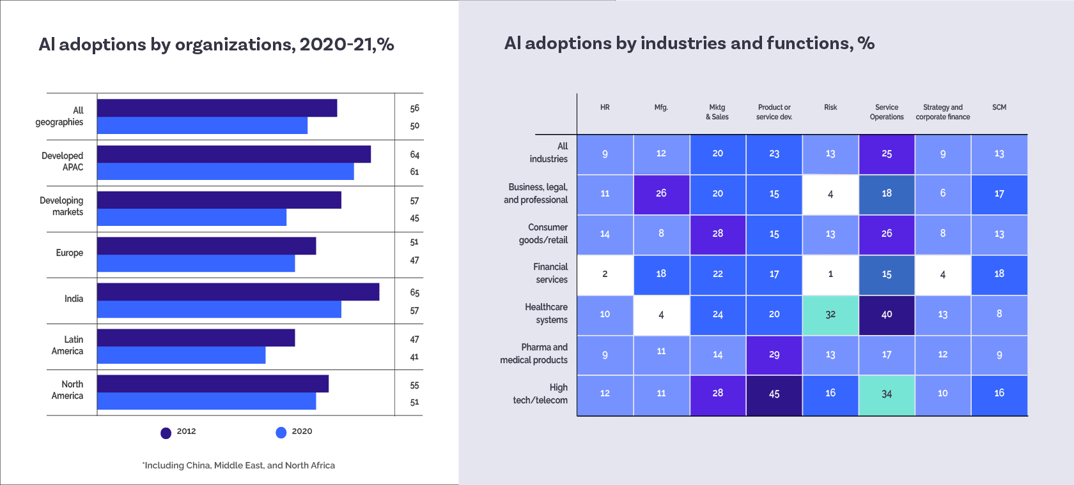
Continuous adoption enabled by financial investment and development
Significant AI technologies
|
Machine learning |
According to the Fu Foundation School of Engineering and Applied Science, “machine learning is a pathway to AI.” This branch of AI applies learning to make ever-better decisions by using algorithms to automatically discover patterns and learn insights from data. Use cases: Fraud detection and prevention (banking and finance industry), image recognition, speech recognition, schedule optimization, etc. |
| Natural language processing |
Machines can now comprehend human language with the help of an AI field called natural language processing (NLP). Its objective is to create computer programs that can comprehend text and carry out automatic tasks like topic classification, translation, and spell-checking. Use cases: Speech recognition, part-of-speech tagging, word sense disambiguation, named entity recognition, co-reference resolution, sentiment analysis, natural language generation, etc. |
| Deep reinforcement learning |
According to viso.ai, deep reinforcement learning is the combination of reinforcement learning with deep learning techniques and is used to solve challenging sequential decision-making problems. Use cases: Robot control, self-driving cars, push notifications, fast video loading, etc. |
| Computer vision |
According to IBM, computer vision is a subfield of ML. AI research in the area of computer vision teaches computers to extract and decipher information from picture and video data. Use cases: Image classification, object detection, object tracking, content-based image retrieval, satellite drought analysis, etc. |
Key future trends in applied AI, per Forbes
- Businesses will begin to get more value out of their AI investments: Organizations used the pandemic as a once-in-a-lifetime impetus to speed up their cloud and e-commerce initiatives. Better data being put into the cloud and more businesses using multi-cloud across industries will enable them to recognize, comprehend, and service their consumers in ways that were previously not feasible. As companies shift their focus from automating internal employee and customer processes to delivering on strategic goals, more companies are reporting better metrics.

- New competitors will upend the cloud industry: Although hyper-scalers have dominated the market, there is still the possibility for new competitors offering boutique services to upend the cloud industry. Per the article, boutique companies that offer distinctive data offerings and "your cloud, your way" services will continue to expand. There has been a noticeable increase in businesses that offer services like data, but it's not just aggregate data. There are cloud services for particular data types, including 3D image data, data services, and a cloud specifically for data warehouse services.
- Hyperscaler specialization increase is expected: The data center market in 2022 started witnessing higher specialization in hyper-scalers, wherein companies can feed data into a prebuilt, industry-specific solution to meet their specific needs. This is being experienced in all kinds of industry verticals with solutions for manufacturing, security, customer experience, and more. As the quality of data matures, AI & ML will become increasingly important tools across verticals, and investments in them will continue to increase.
Real-world examples of applied AI
| Target |
Target is known to use data from clicks and API hits on its websites to forecast user demand, better understand its consumers' buying interests, and deliver targeted, individualized marketing campaigns to people based on these findings. |
| Starbucks |
According to AI Data Analytics Network, Starbucks uses data from its various sources to enable personalized product recommendations and predictive inventory management. It also equips espresso machines with sensors that record and analyze each shot that is made, combined with predictive analytics to identify possible machine repair and tuning opportunities. |
|
AI Data Analytics Network also cites Facebook using AI to accomplish all kinds of intriguing things, from detecting hate speech to assisting advertisers in more effective customer targeting and personalized marketing messaging. |
|
| Ericsson |
Netscribes explains how this leading telecom brand uses AI to digitize customer experiences with a vision to upsell and cross-sell new products. According to studies, omnichannel cloud communication – the technology that aggregates video, voice, messaging, etc., into one platform – combined with AI technologies can cut expenses by up to 20%. |
Key challenges with applied AI
Although applied AI is on the rise and multiple use cases are popping up, there are certain risks attached to it. The debate around these is expected to set the path for technology in the future.
- Significant upfront expenditure on skills and resources: According to an Information Age article, high upfront expenditure is a significant barrier to entry in creating AI and ML workflows for production. In addition to the high upfront costs associated with data preparation, technology adoption, and employee training, it typically takes a business 17 months to break even and additional months to produce meaningful returns.
- Concerns over privacy and cybersecurity: AI companies already have a disadvantage in the public's eyes when it comes to privacy and cybersecurity. As per the “Cisco 2022 Consumer Privacy survey," 65% of people have lost trust in organizations over their AI practices. Furthermore, 92% of respondents in the survey highlight their organizations’ need to do more to reassure customers about how their data is used by AI.
- Increasing compliance and regulation: The course of AI development will be impacted by new legislation. As the talk around data security becomes firmer, new regulations will emerge that may impact how organizations use data in their AI programs.
- The EU AI Act proposes the regulation of AI using a system like the EU’s General Data Protection Regulation (GDPR), which would include fines for noncompliance that, according to an SHRM article, could equal 2 to 6 percent of the offending company’s annual revenue.
- In December 2021, the New York City Council passed a bill governing the use of AI tools in hiring, with penalties of $500 to $1,500 for violations.
Conclusions
Applied AI has immense potential to transform industries and society by solving real-world problems and improving efficiency. However, its successful implementation requires a proactive approach to addressing its ethical, regulatory, and technological implications. Businesses that embrace applied AI must work closely with stakeholders to identify their needs and design more effective solutions around them.