 Softtek


With the exponential increase of connected IoT devices, including mobile devices, and the introduction of new types of data, such as the transmission of digital, audio, visual, and 3D image sensor data, there is an unprecedented opportunity for users to adopt multiple data sources, generating better predictive insights and increasing their competitive advantages.
According to Keith Higgins. Vice President of Marketing at FogHorn:
“By leveraging the power of Edge Computing and combining it with existing data infrastructure, each organization can complete real-time data analytics and machine learning processes on-premises.
These capabilities correlate existing operating system data with real-time sensor data, maximizing predictive insights for greater operational efficiencies such as uptime, performance, and energy savings.”
New mindset changes
The arrival of Edge Computing has swept away some of the preconceived ideas before, and even cloud providers who had previously expressed their opinions stating that in the future “all information would be in the cloud”, have begun to change your mind.
For example, AWS announced in November its AWS Outposts service, which allows customers to run AWS on-premises and then connect to the AWS Cloud. To accomplish this, AWS sends customers fully managed racks of AWS-designed compute and storage hardware running VMware.
But there’s more, soon Microsoft will release new functionality for its own IoT service, Azure IoT Edge. These announcements clearly show how, both AWS and Microsoft have realized that the cloud alone will not be enough to provide the performance needed for the growing number of IoT applications.
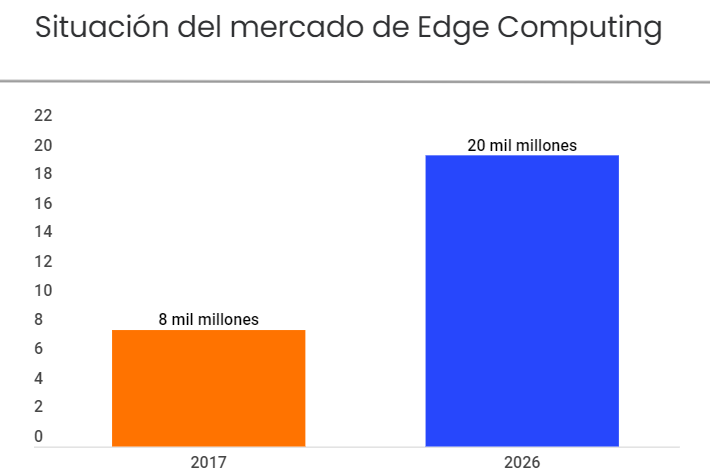
The interest of cloud providers, technology providers and investors in Edge Computing is easy to understand as this market is expected to exceed $20 billion by 2026, up from $8 billion in 2017.
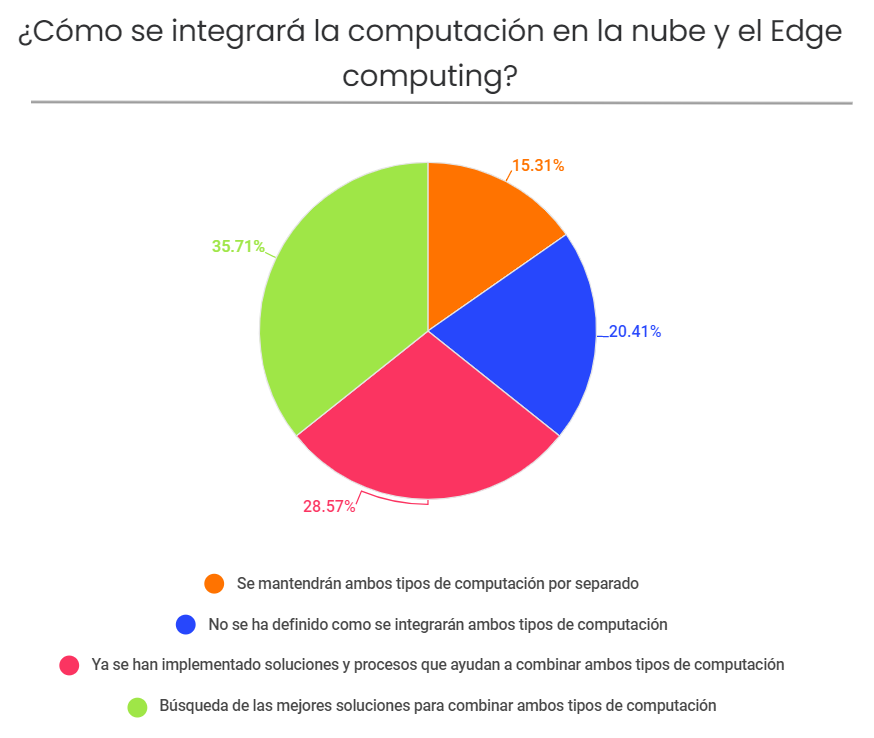
This is not to say that on-premises or cloud hubs will disappear completely, however, 80% of the companies are expected to close their traditional data center by 2025, compared to 10% in 2018. In addition, according to the latest surveys, almost 90% of the companies have already considered investing in an Edge Computing strategy in the next 12 months.
Performance, the main trigger
The capital that will reach the market is important, however, that interest on the part of the various players in the sector is ultimately driven by a known technical weakness in public models working exclusively in the cloud: the Performance.
Applications, workloads, and datasets that require near-instant response get worse when they’re away from the users who work with them.
It is at that point that Edge Computing demonstrates its strengths against the cloud, allowing data to be aggregated at an on-premises point of presence, ensuring a very low-through, low-latency processing option.
One example of the rise of this technology is the California-based Pixeom company, which has developed Edge Computing software for business, for which it has raised $15 million in funds led by Intel Capital, following the investments of the Catalyst Fund from Samsung and power distribution company National Grid.
The platform developed by the Californian company allows cloud service providers to package and organize containerized applications such as those found on Google Cloud Platform, Amazon Web Services, or Microsoft Azure, so they can running on a state-of-the-art infrastructure comprising a range of hardware and operating systems.
Using “advanced versions” of artificial intelligence, data processing, messaging, stream processing, and analytics services recreated to match local APIs, administrators can create and send containerized applications (or adapt existing apps) and publish them to public or private portals, from where they can be installed on edge devices and managed on-premises.
Edge AI artificial intelligence
As already seen, Edge Computing has not been immune to artificial intelligence, and is that due to the increase in the number of IoT devices, there has been a growing interest in creating artificial intelligence applications closer to where they are produced and consume the data.
Edge AI is especially useful in cases where real-time information is critical and changes can happen quickly, such as in video surveillance, where the application may need to predict the behavior of individuals as it occurs.
Xnor, one of the companies that develop advanced artificial intelligence devices that stands out for its focus on improving costs and energy consumption, created an AI tool for object detection that could run on a Raspberry Pi Zero has recently given way further and developed a smaller, more efficient device that replaces the Pi Zero. This is an FPGA, an Edge AI device running on a 30-layer convolutional network that can analyze up to 32 frames per second.
However, despite all its advantages, this type of computing does not come uncompromising, and today the flexibility and computing power of the cloud cannot be replicated at the edge.
The automotive sector
It is worth noting the application of Edge AI in the smart vehicle market, where sensors must act instantly on specific topics, such as a pedestrian appearing suddenly on the road, for example.
In 2017, Domino’s and Ford Motor Company developed a delivery system that uses autonomous vehicles to deliver pizzas. The system tracks GPSed vehicles, notifies the customer about the progress of the order and uses a mobile app to send a code that allows food to be recovered. Companies used edge AI to provide data, geolocation, expected time frame, and customization for updates.
Edge IA allowed Domino’s and Ford to gain valuable insights into customer experiences, such as whether customers cared about walking to the vehicle where the pizza was. For Ford, success meant increased sales of self-service vehicles and Domino’s increased operational efficiency and improved customer experience.
Having seen Japan’s sales of vehicles decline as the need for health care options for an aging population increased, Toyota realized it could take advantage of existing AI-based robotics designed for manufacturing to help people with limited mobility.
That’s why he created the Welwalk WW-1000, a robotic leg device that allows people with partial paralysis to walk, and the BLAID Project, which helps blind or low-sighted people gain better environmental awareness.
The hotel sector
On the other hand, the hotel industry is also profiting from this union, as is the case of the Marriott hotel chain, which partnered with Samsung and Legrand to use IoT devices and edge artificial intelligence to create the first hotel room IoT device-enabled worldwide.
These are highly customized rooms in multiple locations, allowing customers to configure their rooms exactly as they wish based on the information stored in the app.
Conclusions
The growth of Edge Computing is due, like many other successes within the technological field, to the growth of other technology, in this case the excessive increase of Internet of Things devices.
Any industry industry industry that can benefit from timely analysis of IoT data streams should be interested in Edge Computing. That’s why there are now great opportunities for suppliers at all levels of this technology, whether standards, networks, computing, storage, applications or services.
In addition, the union of this technology with another such as artificial intelligence will facilitate the advancement and integration of these devices into everyday life. However, over time, artificial intelligence will not be limited to just one type of computing, but will be divided into cloud-native, edge-native, and hybrid applications.
The point is to understand the opportunities and power found in artificial intelligence and choose the solutions that best suit each use case.