
 Softtek


To compete in a globally integrated economy, today’s organizations need a complete understanding of markets, customers, products, regulations, competitors, suppliers, employees, and more. This understanding requires the effective use of information and analysis.
Along with their employees, many companies consider information to be their most valuable and differentiated asset. Now, with the emergence and expansion of Big Data adoption, organizations around the world are discovering new ways to compete and win, transforming to leverage the wide range of information available to improve decision-making and enterprise-wide performance.
The benefits that Big Data will bring
While 74% companies expect broad benefits from data analysis by the end of 2019, most are still not seeing these results. In fact, only 12% of those using Big Data are experiencing tangible benefits.
This is a constantly moving field, so it can vary in a short time. To help companies better understand the current state of data analysis and how it is progressing, it is important that companies pay attention to a number of points:
- Initiatives integrated into the business culture:
It is necessary for the company as a whole to assume the need to integrate data analysis into its business culture, thus creating new solutions that can respond to the needs of the business. However, this culture has been difficult for more traditional professionals to understand.
Mos of one in five business leaders currently rate their Big Data strategy as “optimal,” suggesting that their practices are not yet up to their ambitions.
- Proliferation of unstructured data:
Unstructured elements such as audio and video will change the way data is collected. In the past, data has remained without any organization, however, by passing unstructured data into a structured format, organizations can turn it into actionable information.
- Need for real-time models:
In the past, analyses focused on long-term goals, which means analyzing information throughout the year and then making decisions based on that past information. As technology advances, companies will be able to use real-time analytics. For example, by 2022, 30% of customer interactions will be influenced by real-time location analysis.
- Trusted Tool:
Analytical tools will continue to be easier to digest for those with extensive statistical experience. This is because, those who know the business and know how to use the tools are the ones who apply them and answer the questions that arise.
- Increased movement towards automation and artificial intelligence:
By 2023, the computational resources used in AI will increase 5 times over 2018, making artificial intelligence the primary category for driving infrastructure decisions.
AI and automation will continue to progress, becoming more dynamic and complex, enabling real-time modeling. On the other hand, the use of the cloud to store all the information collected will be indispensable.
Although 78% of the organizations are already running big data workloads in the cloud and 82% has a strategy to move existing applications to the cloud, only one in five have an “all cloud” strategy, and 54% uses a cloud combination and apps on-premises.
How will you help in the customer-company relationship?
While most companies recognize the importance of implementing Big Data initiatives, many still struggle with implementation, nearly 70% of companies have made establishing a data-driven culture a priority, however, only 40% is reaching the finish line. However, you can define a number of common trends in all of them:
- In most industries, the main goal of Big Data adoption is on the figure of the customer.
- Scalable and extensible information management.
- Companies are starting their pilot projects from existing use and recent access to internal data sources.
- Staff with advanced analytical capabilities are required and aware of the organization-wide involvement with Big Data.
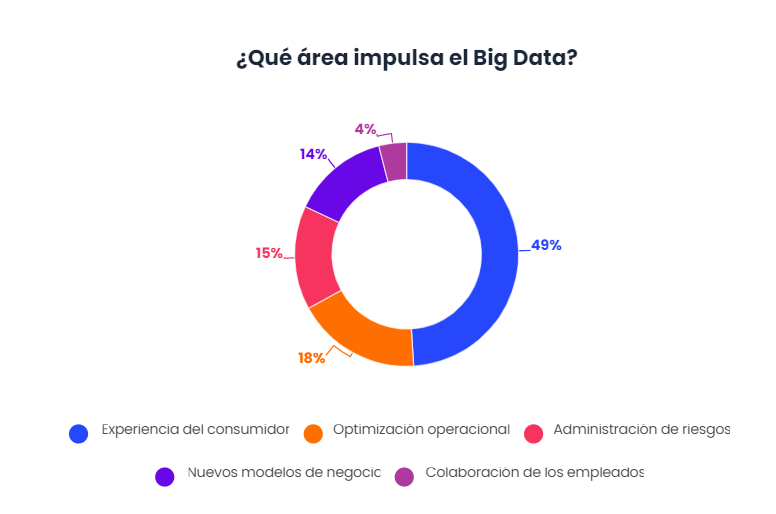
More than half of companies consider improving the customer experience as a priority within their Big Data integration strategy. Today, companies clearly see that big data provides the ability to improve, understand, and predict customer behaviors, and in doing so, improve the customer experience.
Transactions, multi-channel interactions, social media, data extracted through sources such as loyalty cards, and other customer-related information have increased the ability of organizations to create a complete picture of customer preferences and demands.
Through this deeper understanding, organizations of all kinds are finding new ways to engage with existing and potential customers. This principle clearly applies in retail, but equally in the telecommunications, healthcare, government, banking or consumer products sectors where end consumers and citizens are involved, and in interactions between companies, partners and suppliers.
In fact, Big Data can be a two-way street between customers and organizations. For example, connected vehicles produce large amounts of data, with information engineers learn about customers’ driving habits.
Regarding the retail sector, making data-driven decisions is imperative. A greater focus on service delivery can often be the key differentiator among competitors. This means that it is essential that stores really know their customers.
From their preferred method of communication to their shopping habits, retailers have many of this data at hand, which can help create customers for life. In today’s hyper-customized world, consumers not only expect, but demand personalized shopping experiences.
Today, shoppers are inclined to pay extra for a personalized service or experience. From self-testing, hyper-personalized experiences, and the introduction of messaging apps, customers are changing the way brands interact with them, both in-store and online.
By leveraging data, retailers can create a truly unique experience. While some may think that consumers are more concerned about the latest and greatest products, they are actually more in tune with how their needs are met.
Creating exceptional customer experiences is what companies expect. If a part of that experience is ruined, it could damage the customer’s opinion about the company. So making sure that companies are properly leveraging the data they’ve collected can seem like a daunting task, but when done correctly, customer happiness can become lifelong loyalty, leading to a company Successful.
Big Data is also not without problems
Recent data breaches have discovered a great risk associated with digital transformation—a loss of customer confidence. There is a disconnect between how organizations use customer data and how customers think their data should be used.
At the moment, more than half (57%) of customers blame companies over anyone else, including criminals, in the event of a data breach. About 48% of consumers do not believe there is any ethical way for organizations to use personal data.
It is important that companies have a number of requirements in mind about the customer’s privacy expectations:
- The importance of context:
While all customers are concerned about their financial data and passwords, other major concerns vary based on personal background. Organizations should consider each consumer’s personal context, whether age, nationality or gender, when implementing data policies.
- Privacy expectations are cultural:
Privacy policies may affect consumers differently depending on where they are. For example, the GDPR affects those who live or handle EU data, however, not those outside the EU.
Data privacy may change due to cultural factors, events, or high-profile data breaches in specific countries. Companies, especially global ones, should consider how regulations could affect consumers in different countries.
- Customization is still a puzzle:
While personalization can increase user activity and business revenue, consumers don’t feel that their data helps businesses deliver more personalized services. That’s why companies need to communicate to their consumers why and how they’re going to use their data to improve trust and personalization.
Big Data Will Drive The Best Job Opportunities
In order to counter this situation, companies must be prepared, and for this they must have a workforce at the level.
At this time, Big Data, machine learning and information science are expected to generate the best job opportunities during 2019. Strong hiring activity is expected to continue as roles expand into senior engagements, given increased demand for senior executives with experience in business management.
As companies focus their efforts on professionalizing their operations, there will be increased demand for talent in business association functions such as human resources, finance, and legal affairs. In particular, recruitment activity in the technology sector is expected to grow significantly with new CTO and CIO. The rapid advancement in the digital space has led to an increase in the demand of experts especially in Big Data.
The 36% of companies seeking to leverage Big Data knowledge lack staff with the required expertise. That’s why organizations need to train each data worker, regardless of their technical skill, to perform business process automation.
Self-service analytics will become the most precious skill, where employees can collect data from different sources, transform and analyze that data within a code-free environment, and determine its final state.
Traditional data cataloging solutions do the heavy lifting of IT, yet it’s time for organizations to see the advantage of helping analysts from different business silos come together to interact with and between data.
This type of social collaboration, involving the business user, is critical to the advancement of data strategies, and will help organizations look beyond corporate data assets, such as external sources that can enrich the case and provide better results.
How to attract talent?
While much of automation is involved in data analysis and management, a high level of human development and monitoring is still required to ensure that these automated systems work effectively.
Data engineers, DevOps specialists, software engineers, data scientists, etc. are needed to help companies develop a successful data strategy.
People with different roles will still be needed to build these analytical models. However, many of the time-consuming management and monitoring tasks will be eliminated.
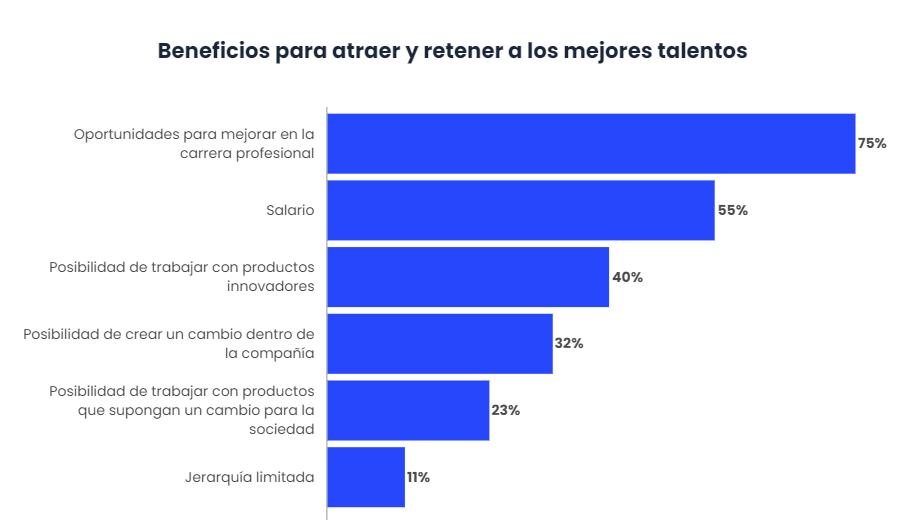
Of course, it goes without saying that rewarding the talent for what it is worth is vital to attracting the right people. About 55% executives acknowledge that workers expect to receive a salary that matches the industry average for their specific role.
Without neglecting, the ability to create changes and work with innovative products is valued more than wages, particularly for the millennial and Gen Z generations.
Unlike its millennial counterparts, the Gen Z prefers the opportunity to work on a project aimed at changing the world, leaving wages and increases further down in the classification of the essential requirements. Incontrast, workers belonging to baby boomers are the only ones who rank wages and raise disequal to career advancement.
Conclusions
Big Data is currently one of the most critical emerging technologies. Organizations around the world seek to exploit data growth to unlock previously hidden information in the hope of creating new revenue streams, gaining operational efficiencies, and gaining a greater understanding of the needs of customers.
It’s important to think about big data and analytics together. Big data is the term used to describe the recent use of different types of data from different sources. And analytics tries to examine this data to derive interesting and relevant trends and patterns, which can be used to make decisions, optimize processes, and even drive new business models.
Because of today’s avalanche of data, problems arise with processing that data, gaining the right skills to manage and analyze that data, and establishing rules governing the use and distribution of data.
Within this technology, a viable option is cloud computing to host Big Data workloads. However, working in Big Data in the cloud brings its own challenge by having to reconcile two contradictory design principles.
Cloud computing is based on the concepts of consolidation and resource pooling, but big data systems are based on the principle of not sharing anything, where each node is independent and self-sufficient. This requires an architecture that allows these mutually unique principles to coexist to truly exploit the elasticity and ease of use of cloud computing for big data environments.