
 Softtek


One of the challenges companies face is understanding how to manage their innovation resources. This challenge makes them wonder whether they should adopt more disruptive and risky ideas or instead focus more on progressive innovation, improving their current products.
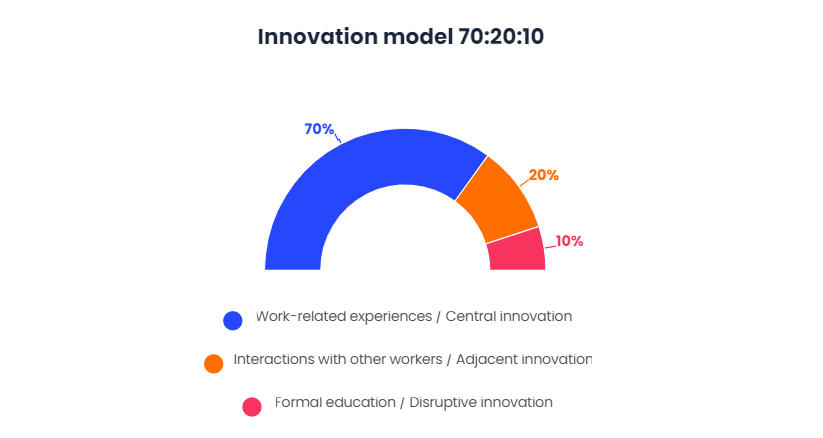
Today, many organizations have adopted the 70:20:10 model to drive innovation. It is a model that is based on the proportion of knowledge gained from three sources: work-related experiences, interactions with other workers, and formal education events.
This model is often part of organizational development programs, while allowing executives to be at the forefront when planning training or training activities. It goes against the typical “learning” approach to development, which has gone out of fashion in many areas in recent years.
The benefits are there, you just have to identify them.
The initial idea is simple, the company concerned must concentrate on its core responsibilities to make the business work, however, can not devote all their efforts to it, because if it does, will never evolve or innovate.
- 70% Central Innovation:
Focusing on innovation means improving current products and services that align well with the organization’s strategy. It also means allocating 70% of resources to proven, low-risk core activities that have proven to work in the past.
As core activity focused innovation generally covers existing processes and customers, costs for increased production and adoption tend to be lower.
For this reason, more innovative technology companies such as Google and Apple focus most of their resources on improving the existing product portfolio. This means that a company must concentrate most of its resources to maintain innovations.
- 20% Adjacent Innovation:
It is useful to think of innovation projects as a strategy which needs diversity to reduce risks and achieve a balance. This is why, along with core activities, companies begin to explore new markets and capabilities.
However, focusing too much on adjacent opportunities may be more risky than focusing on core innovation projects. Therefore, concentrating on this type of innovation should only occupy about 20% of resources.
Even if the company decides to bet on new markets or products, this does not mean that it will be an exclusive novelty, as these products and markets usually already exist somewhere, even if they do not form part of that company’s catalogue.
- 10% Disruptive innovation:
To think ahead and reach the next big milestone, innovative companies can focus 10% of their resources on developing breakthroughs and creating new products for markets that do not yet exist.
This means considering transformation initiatives that focus on creating something completely new. Disruptive innovation can often be defined as the introduction of a new technology that creates a new industry and transforms the way things are done today.
Every company needs adjustments
Model 70:20:10 is a general rule, not a rigid model. It is not necessary to strictly follow the exact allocation of resources to innovate. However, it is useful to apply this model as a guide to effectively manage innovation resources.
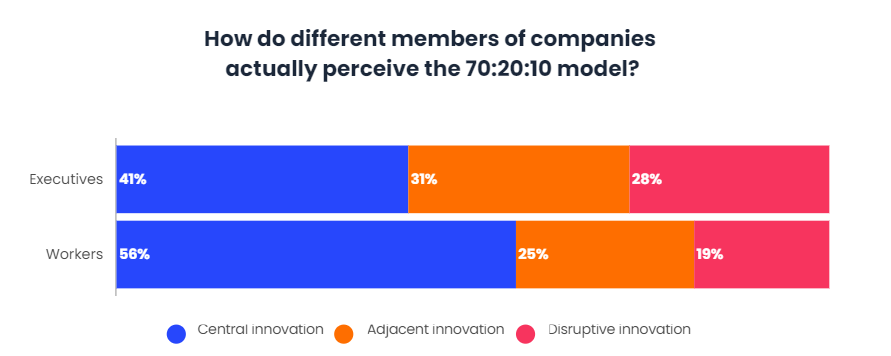
According to each company, it will be necessary to adjust the proportion according to the prevailing context and risk capacity. In addition, each company will have to take into account different aspects:
- Talent:
Central, adjacent and disruptive innovation will require diverse skills and talents. Different studies show how some skills are best obtained from the outside, while others are best developed internally to foster innovation.
- Integration:
Central innovation could work well next to the core business, while disruptive innovation teams should be separated from the core business.
- Funds:
The basic and adjacent innovation costs are additives, while disruptive innovation may require a dedicated initial investment.
- Pipeline Management:
The criteria for moving projects through the innovation process are different. While incremental and adjacent innovation projects are handled more or less in the linear model, for example, the stage model, the correct approach to transformational innovation cannot be linear, as it is difficult to find an approach to a market or a product that does it which does not yet exist.
- KPI:
Key performance indicators should support the types of innovation they tend to measure. KPIs used to measure the success of central and adjacent innovation may not capture transformation efforts or even make them look like failures.
More effort means more profit
According to the latest research, companies that invest 70% of their resources in core innovations, 20% in adjacent innovations, and 10% in transformational innovations generally outperform their peers and have a higher cost-to-profit ratio.
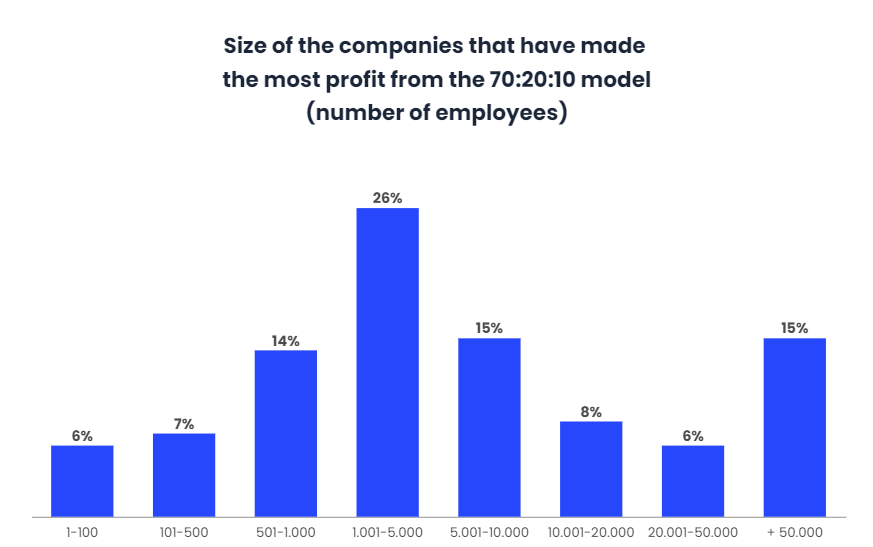
To do this, successful innovation managers create a balanced portfolio of core, adjacent, and disruptive opportunities and ensure that their organizations support a sustainable allocation of resources to innovate.
However, this success not only resides in the internal organization of the company, but is accompanied by the introduction of novel technologies, which provide the resources necessary to extract all possible profits from the 70:20:10 model.
- Virtual Reality
Virtual Reality (VR) is an ideal solution for corporate training in manufacturing, energy, defense and other industries. With VR, people can practice their skills until they have confidence in them, and then start work with confidence.
- Augmented Reality
Augmented Reality (AR) can drive employee engagement as well as virtual reality. But compared to VR, it’s much more affordable. That’s why most companies are still focusing more on AR.
- Gambling
Games are actually a good tool for learning and improving training. They present a person with a challenge and make them develop their skills. For example, it helps train new workers while immersing them in the company’s internal culture.
- Interactive videos
Another way to develop tacit knowledge is through videos that employ a scenario-based learning design. This study approach provides open situations for employees to make decisions and reflect on the process.
- Social Networks
Social Networks, as a starting point for communication between workers, is very interesting for adjacent innovation. These tools allow workers to share their different points of view and discuss the future of new projects.
- eLearning
This type of learning compared to instructor-led training is more beneficial because, at a minimum, it saves the company money, allowing it to personalize the learning process and increase employee morale.
- Mobile Learning
Many employees believe that training does not have to stop after hours. In addition, most employees value the ability to learn anytime, anywhere, so mobile learning is beneficial to both businesses and workers.
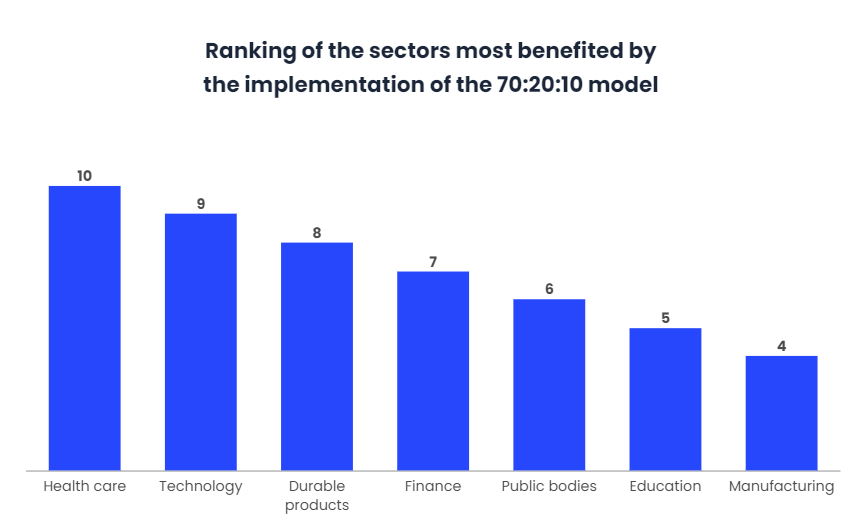
Regardless of the tools used and the percentage assigned to each part, the 70:20:10 model emphasizes that learning is more than just traditional training. Companies, regardless of the sector to which they belong, will benefit when there is a good combination of learning sources.
Conclusions
Innovation is one of the worst terms used in the corporate world, as it is too often used to describe a result or end point: the launch of a new product, the development of a new piece of technology. However, the reality is that innovation is not a thing, but rather the process of discovering something that brings new value to people’s lives.
Faced with this situation, companies need to re-imagine the way they operate: the way teams are structured and the way investment is allocated to create a space that allows innovation to thrive.
Part of this is about creating widespread cultural change and incorporating new ways of working, especially when trying to implement a learning model based on 70:20:10.
However, thanks to modern technology, the 70:20:10 framework can be more flexible than ever. The best thing each company can do is to find the ideal balance between the resources at its disposal to make the learning process better.