 Softtek


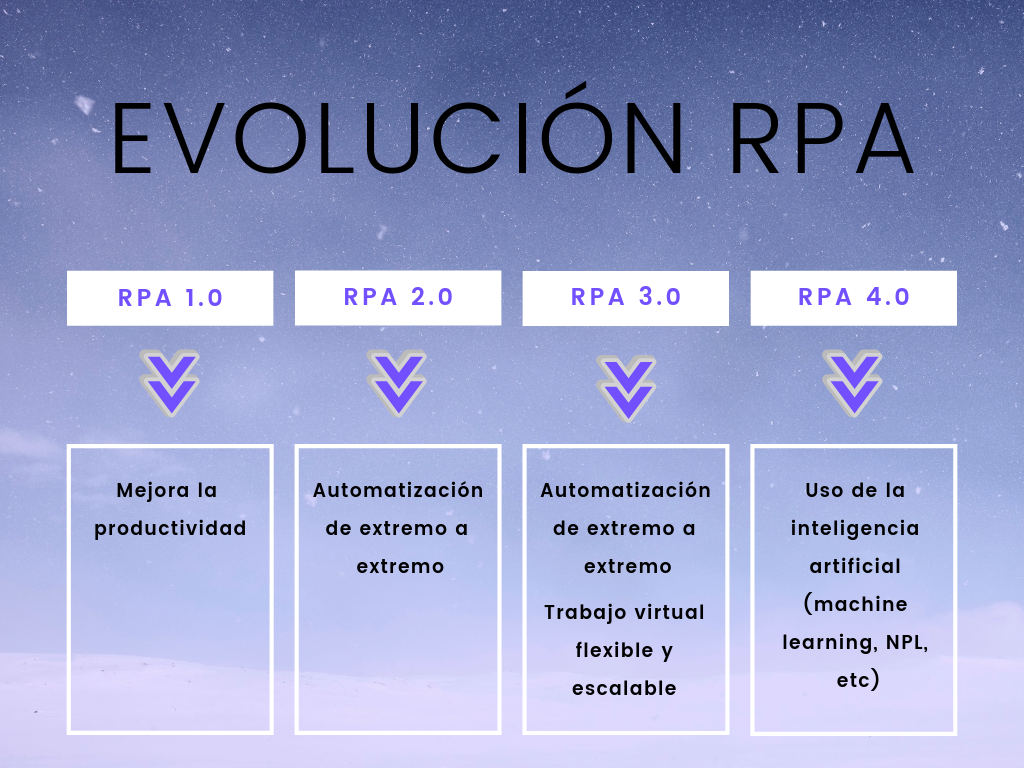
The future of automation is closely related to artificial intelligence, and that is the direction in which the robotic process automation (RPA) subset is also directed. The automation market is expected to continue to grow at a compound annual growth rate (CAGR) of 29% to 2023.
Digitization has already proven to be an indispensable tool for business growth, not only for savings, but also for stimulating employees’ imagination and for impressing and loyalizing customers.
The state of the RPA market
Since its inception, RPA solutions have followed a path of uninterrupted growth and innovation, so adoption of the RPA market is considered to be “methodical” and that more than 4 million robots will be in production by 2021.
However, it is well known that market share does not necessarily translate into innovation. Yahoo!, MySpace and BlackBerry are perfect examples. The key to innovation in the RPA field lies both in responding to and anticipating the future needs of customers.
During 2018, RPA solutions have followed the pattern of many software markets: the most striking features are the most successful and companies ask suppliers for a number of “must-have” capabilities.
However, customers don’t always know what they want, so it’s important that RPA providers anticipate customers’ future needs before they can do it themselves.
Currently, 53% of the companies are already immersed in RPA solutions, and 19% of those that have not, will start in the near future, and that is an increasingly competitive business world at the economic level, the cost reduction that this entails , is no longer an option.
The future of the RPA
The use that has been given so far to RPA processes is clear, however what trends will continue during this 2019 and in the coming years?
- The architecture of RPA solutions will evolve as the enterprise, safely.
Many companies have launched a proof of concept (POC), which to scale across the enterprise requires not only business entries such as a roadmap and a Center of Excellence (COE), but also an enterprise-class RPA architecture that can scale cost-effective in all use cases, business units, divisions and global offices.
- Bot construction will become self-service:
Nearly 10 years ago, the gap between what applications can do and the unmet needs of the user were already a recurring theme for companies. This gap is mainly due to the unavailability of IT resources and the justification of costly programming resources.
In the new digital workforce, a generation of “Citizen Developers” will emerge, in addition, in the future business users will be able to build their own robots. This capability will transform the RPA value again.
- Artificial intelligence and RPA solutions will solve more business problems:
Tech media and some marketing providers treat artificial intelligence as if it were a magic box, however, virtual assistants like Google, Alexa or Siri offer unintelligent answers.
For example, Facebook’s algorithm recently marked an excerpt from the U.S. Declaration of Independence as a “hate speech” and removed the post.
The first generation of customer service chatbots that replaced humans failed in this regard. Early adopters of technology quickly discovered that people asked all sorts of questions they hadn’t anticipated and for which devices had no answer, which is why many AI implementations today are used as support humans and not to replace them completely.
Artificial intelligence and RPA
As mentioned, incorporating AI into RPA solutions can make technology even more efficient in the near future, such as in the automation of cognitive documents or in the automation of smart screens
- Cognitive Document Automation (CDA):
The CDA processes structured and unstructured content, especially in business processes that involve document handling. An AI-driven RPA solution can become more efficient over time.
As more documents are processed, the solution learns to intelligently manage variations regardless of the channels through which information is exchanged, whether electronic channels such as emails, web portals or paper Physical.
Among others, an AI-based RPA solution that includes CDA can recognize the arrival of an invoice, identify which vendor it comes from and its associated purchase order, and then trigger an action in the Accounts Payable system, all without human interaction.
- Smart Display Automation (ISA):
The ISA uses an artificial neural network to analyze an image of an application. This is required, for example, when applications are running in Citrix or other remote desktop environments and only image information is available.
That virtualization is used in almost every process has become an increasing problem for an RPA solution to connect and work with environments that only return image information.
In this case the ISAs solves this problem by automatically creating UI objects for the robot designer to use in creating the software robot. This results in significantly faster robot development and avoids the problem of standardizing screen resolution, as the robot does not depend on the position of the screen to select menu items when performing tasks.
Now and in the future, the combination of AI + RPA by companies will focus on trying to choose the right cognitive moment. All the excitement around RPAs and artificial intelligence is contagious, however, it is important to have a solid understanding of what the two technologies do separately and how they can be combined in the most effective way to bring maximum value to your Organization.
All of these two technologies make up the new intelligent digital workforce that frees workers to be more effective in their work and help make better decisions.
Conclusions
While interest in robotic process automation (RPA) continues to grow, clarity about what this technology is, how it can be successfully adopted, and where it is headed is not as clear.
Industry analysts hope that combining RPA solutions with even smarter technologies will have great potential for widespread adoption across industries. Machine learning and cognitive computing, for example, are technologies that involve computer or software learning beyond its initial programming, much like a human would do in similar situations.